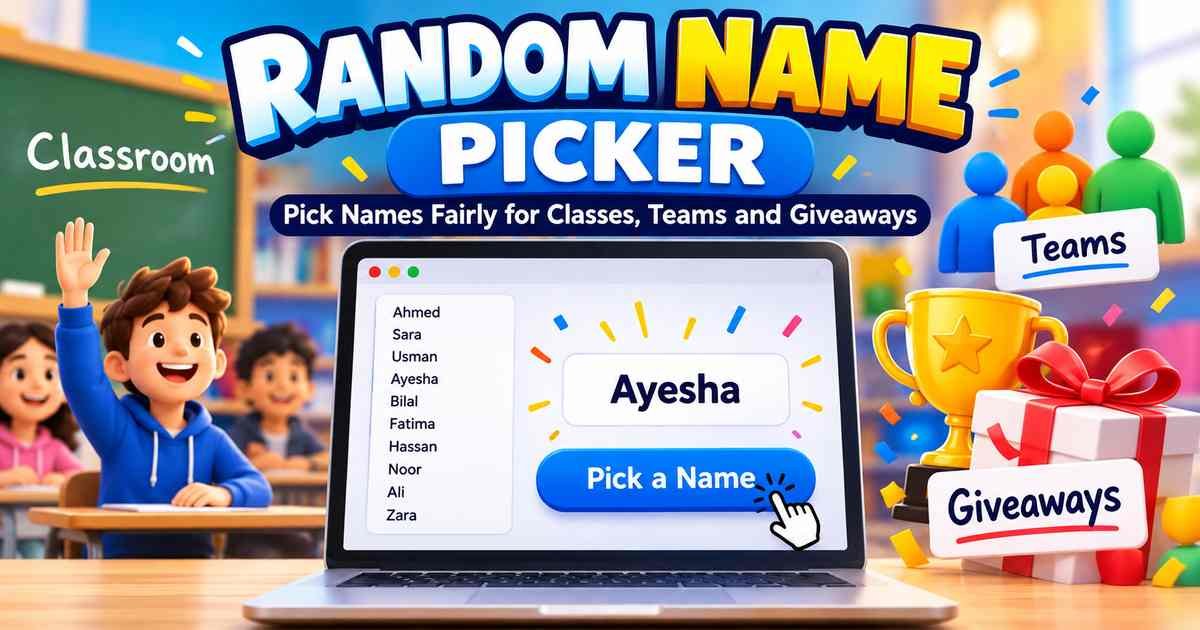
Choosing one name from a list sounds easy, until people ask, “Why did you pick me?” or “Was that really fair?” A random name picker removes that problem. You enter the names, press a button, and the result is decided by chance, not by anyone’s preference.
This guide explains what a random name picker is and how to pick a name from a list fairly. It also covers classrooms, multiple winners, no-repeat picks, teams, giveaways and privacy. You can try it yourself with the free random name picker on RandomsDex.
What Is a Random Name Picker?
A random name picker is an online tool that selects one or more names from a list at random. Many people also call it a random name generator, a random student picker or a random winner picker.
Note that “random name generator” can mean two different things:
- Picking from your own list. You supply the names, and the tool chooses among them. This is what a name picker does.
- Inventing new names. Some tools create made-up names for characters or stories. That is a different job.
This article is about the first kind: choosing from names you already have.
How to Pick a Random Name From a List
The steps are the same for almost any name picker:
Step 1: Write or paste your list of names, one name per line.
Step 2: Check the list for typos and duplicates.
Step 3: Choose how many names you want to pick.
Step 4: Press the pick button.
Step 5: Use the result, and keep a note of it if others need to see proof.
In a fair picker, each name has an equal chance. With 20 names, every name has a 1 in 20 chance, which is 5%.
Watch for Duplicates
If one name appears twice, that person has double the chance. This is a common accident when you paste names from different lists. Remove duplicates, unless you are deliberately giving some people extra entries.
Using a Random Name Picker in the Classroom
Teachers use a random name picker for the classroom because it keeps participation fair and helps shy and confident students equally.
Good classroom uses include:
- Choosing who answers the next question
- Deciding who reads aloud or presents first
- Picking a helper for the day
- Calling on students without seeming to favour anyone
- Selecting a student to check homework answers on the board
Student Selection Tips
- Mix easy and hard questions. A random pick can land on any student, so keep questions friendly.
- Allow a “pass” or “phone a friend.” This keeps the activity low-pressure.
- Use no-repeat picks. This makes sure everyone gets a turn before anyone is picked twice.
- Use first names only. This protects privacy (more on that below).
If you want to use numbers instead of names, a random number generator works too. Give each student a number, then generate a number in that range.
Picking Multiple Winners
Sometimes you need more than one name, for example three winners for a prize draw. The picker chooses one name, removes it from the pool, then picks again.
Here is a surprising fact: every name has the same overall chance, even though the picks happen in order.
Example: 3 winners from 20 names
First pick: each name has a 1 in 20 chance.
Overall, each person’s chance of being among the 3 winners is 3 ÷ 20 = 0.15, which is 15%.
The order of picking does not give anyone an advantage. Being picked first does not help, and being picked last does not hurt.
No-Repeat Selection
“No repeats” means a name, once picked, cannot be picked again in the same round. This is also called selection without replacement.
It matters for:
- Prize draws, where one person should not win twice.
- Classroom turns, where everyone should speak before anyone speaks twice.
- Presentations, where you are building a speaking order.
If repeats are allowed, the same name can come up two times in a row. That is not a fault. It is how independent picks work. For example, with 10 names and 3 picks, there is a 28% chance of at least one repeat, because 1 − (10 × 9 × 8) ÷ (10 × 10 × 10) = 1 − 720 ÷ 1,000 = 0.28.
You can read more about this difference in our guide on selection with and without replacement.
Making Teams and Groups
You can also use a picker to split people into teams. The simple method is to shuffle, then deal.
Example: 12 people, 3 teams of 4
Pick names one by one without repeats.
The first 4 names go to Team A, the next 4 to Team B, the last 4 to Team C.
Some tips for fair teams:
- Do the draw in public. Everyone can see the process.
- Do it once. Re-drawing until you like the teams is not random.
- Handle special cases first. If skills must be balanced, split people into skill groups first. Then draw randomly inside each group.
Random teams will sometimes be uneven by chance. If balance matters more than chance, choose teams another way.
Using a Random Name Picker for Giveaways
A random winner picker is popular for social media and website giveaways. It helps show that the winner was not chosen by favour.
For a clean giveaway:
- Publish the rules first. Explain how to enter, the deadline, and how the winner is chosen.
- Build one clear list. Include each valid entry once, unless the rules say extra entries are allowed.
- Remove invalid entries. For example, remove duplicates, late entries or entries that break the rules.
- Pick publicly if you can. A screen recording or live pick adds trust.
- Keep a record. Save the list and the result.
- Choose a backup winner. If the first winner does not respond, you have a plan.
Giveaway rules and legal requirements vary by country, and social platforms have their own rules. Check the platform’s terms and the local rules before you run a prize draw. A name picker helps with fairness, but it does not replace those rules.
Is Random Selection Really Fair?
A random pick is fair when three things are true:
- Equal chance. Every name on the list has the same chance.
- A fair list. The list includes everyone who should be there, with no duplicates.
- No re-rolling. You accept the result and do not repeat the draw until you like it.
Random does not mean “evenly spread.” You might see the same name picked twice in a short time, or one team full of friends. That is normal for a random process. It does not mean the tool is biased.
Random picking is not the right method when a decision should depend on merit, such as grades, job offers or awards. Chance should not replace judgement there. Our article on how random selection works lists more situations where random choice is not a good fit.
Privacy: What to Think About Before You Paste Names
Names are personal data, so a little care goes a long way.
- Use first names, initials or numbers for students and minors.
- Do not paste private details, such as phone numbers or email addresses, if you only need names.
- Check the privacy policy of any online tool you use. This tells you what the site does with the data you enter.
- Follow your school or workplace rules on sharing names with online services.
If you are not sure, use nicknames or numbers. The pick will work just as well.
How to Use the RandomsDex Random Name Picker
The RandomsDex Random Name Picker is free and works in your browser. In general:
- Open the tool and type or paste your names, one per line.
- Review the list for typos and duplicates.
- Choose how many names to pick, if the tool offers that option.
- Press the button to get your result.
You will find other tools of this kind in the random tools category. If you need a quick yes or no answer instead of a name, try a yes or no generator.
FAQs
How does a random name picker work?
It takes your list of names and uses a random number to choose a position in the list. The name at that position is the result. A fair picker gives every name the same chance.
Can I pick more than one name at a time?
Yes, on most pickers. Choose how many winners you need. For prize draws, use a no-repeat setting so one name cannot win twice.
How do I make sure the pick is fair?
Remove duplicates, include everyone who should be in the draw, and do not re-draw until you like the result. Doing the pick in front of others also helps.
Is a random name picker good for choosing students?
Yes. It is a fair way to call on students and it avoids any sense of favourites. Use no-repeat picks so everyone gets a turn.
Can I use it to split people into teams?
Yes. Pick names one by one without repeats and place them into teams in order. If the teams must be balanced by skill, sort people into skill groups first.
Is it safe to enter real names?
It is best to use first names, initials or numbers, especially for children. Always check the privacy policy of the tool and the rules of your school or workplace.
What is the difference between a name picker and a name generator?
A name picker chooses from names you provide. A name generator invents new names. Many people use the two terms for the same thing, so check what the tool actually does.
Conclusion
A random name picker takes the guesswork and the arguments out of choosing. Prepare a clean list, decide the rules before you press the button, and accept the result. That is what makes the pick fair.
Ready to pick? Try the free RandomsDex Random Name Picker.
Sources and References
MDN Web Docs – Crypto.getRandomValues() (browser source of secure randomness).