Percentages are everywhere in daily life. A shop offers a 20% discount, a bank adds 5% interest, and a teacher gives you 85% on a test. Knowing how to calculate a percentage of any number helps you understand prices, scores, discounts, and statistics without guessing.
Whether you are a student, shop owner, or someone managing daily expenses, learning how to calculate a percentage of any number can make your calculations easier. This guide explains the formula, practical examples, mental math tricks, and common mistakes. You can also check your answers using the free Percentage Calculator on RandomsDex.
How to Calculate a Percentage of Any Number
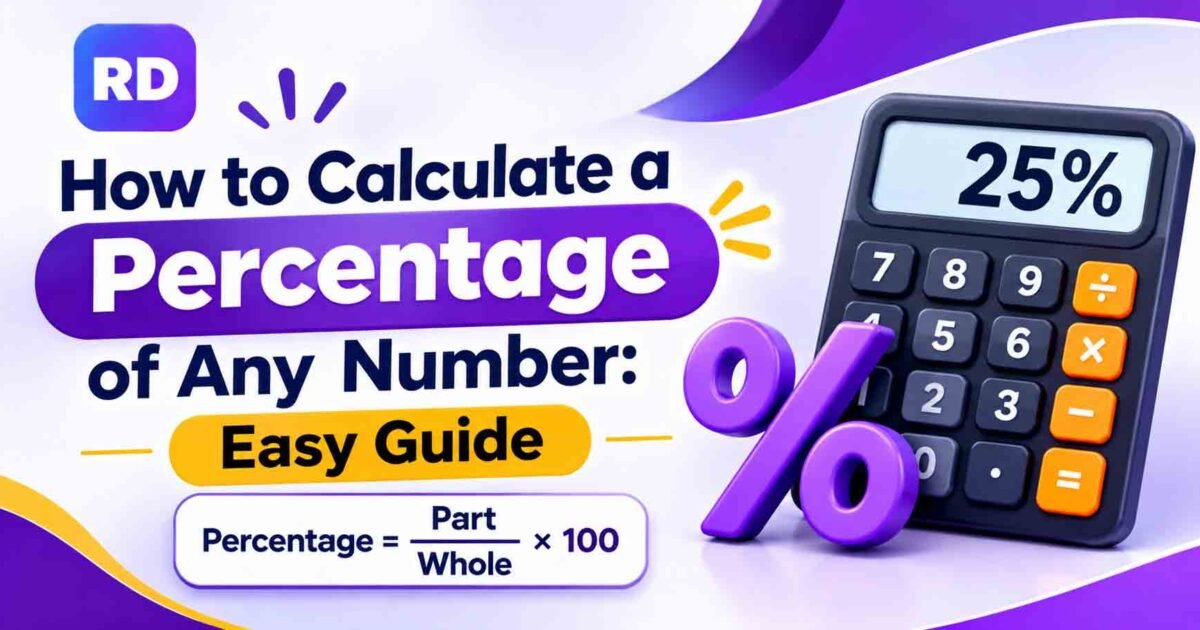
The easiest way to calculate a percentage is to convert it into a decimal and multiply it by the original number. This method works for whole numbers, decimals, and large amounts.
The Basic Percentage Formula
The word “percent” means “out of 100”. For example, 20% means 20 out of every 100.
Here is the basic formula:
Percentage of a Number = (Percentage ÷ 100) × Number
This formula is useful whenever you need to find a specific percentage of an amount.
Understanding how to calculate a percentage of any number becomes easier when you follow the formula step by step.
How to Use the Percentage Formula
Follow these three simple steps:
- Write down the percentage you want to calculate.
- Divide that percentage by 100 to convert it into a decimal.
- Multiply the decimal by the original number.
The final result is your answer.
Step-by-Step Examples of Percentage Calculation
Let’s understand the formula with some practical examples. These calculations will show you how to calculate a percentage of any number using simple mathematical steps.
These simple examples show how to calculate a percentage of any number using different values.
Example 1: What Is 20% of 250?
First, divide 20 by 100:
20 ÷ 100 = 0.20
Now multiply the result by 250:
0.20 × 250 = 50
Answer: 20% of 250 is 50.
Example 2: What Is 15% of 80?
Convert 15% into a decimal:
15 ÷ 100 = 0.15
Multiply it by 80:
0.15 × 80 = 12
Answer: 15% of 80 is 12.
Example 3: What Is 7.5% of 200?
Divide 7.5 by 100:
7.5 ÷ 100 = 0.075
Multiply it by 200:
0.075 × 200 = 15
Answer: 7.5% of 200 is 15.
Example 4: How to Calculate 20 Percent Without a Calculator
There is another easy way to find 20% of a number.
Since 20% is equal to one-fifth, divide the original number by 5.
For example:
250 ÷ 5 = 50
Answer: 20% of 250 is 50.
This shortcut is helpful when you want to calculate percentages mentally.
How to Calculate Common Percentages
Some percentages are easier to work with because they have simple mathematical shortcuts. Learning these values can save time.
Here are some common percentages of 360:
| Percentage | Easy Method | Result |
|---|---|---|
| 1% | Divide by 100 | 3.6 |
| 5% | Half of 10% | 18 |
| 10% | Divide by 10 | 36 |
| 25% | Divide by 4 | 90 |
| 50% | Divide by 2 | 180 |
| 75% | Three-quarters | 270 |
| 100% | Full number | 360 |
These methods help you find common percentage values without repeating the complete formula.
How to Calculate Percentages of Decimal Numbers
The same percentage formula also works with decimal values. You do not need a different method for numbers that contain decimal points.
For example, find 15% of 85.
First, calculate 10%:
85 × 0.10 = 8.5
Now calculate 5%:
85 × 0.05 = 4.25
Add both results:
8.5 + 4.25 = 12.75
Answer: 15% of 85 is 12.75.
You can also use this method to calculate other percentages by dividing them into smaller parts.
Mental Math Tricks for Quick Percentage Calculations
You do not always need a calculator to solve percentage problems. A few simple tricks can help you find answers quickly.
Once you learn how to calculate a percentage of any number mentally, everyday calculations become faster.
How to Find 10% Quickly
Move the decimal point one place to the left.
Example:
10% of 450 = 45
How to Find 1% Quickly
Move the decimal point two places to the left.
Example:
1% of 450 = 4.5
How to Calculate 5% Quickly
Find 10% first and divide the result by 2.
Example:
10% of 450 = 45
45 ÷ 2 = 22.5
How to Find 50% Quickly
Divide the original number by 2.
Example:
50% of 200 = 100
How to Calculate 25% Quickly
Divide the number by 4.
Example:
25% of 200 = 50
How to Find 75% Quickly
Calculate 25% and multiply the answer by 3.
Example:
25% of 80 = 20
20 × 3 = 60
Answer: 75% of 80 is 60.
A Useful Percentage Calculation Shortcut
Here is another interesting mathematical trick:
X% of Y = Y% of X
For example:
8% of 25 = 2
25% of 8 = 2
Both calculations give the same result. You can choose whichever method is easier.
Common Percentage Calculation Mistakes
A few simple mistakes can lead to incorrect answers. Understanding these errors will help you improve your calculations.
1. Forgetting to Divide by 100
If you want to find 20% of 250, you must first convert 20% into 0.20.
Multiplying 20 directly by 250 gives 5,000, which is incorrect.
2. Confusing Percentage Of and Percentage More Than
These two calculations have different meanings.
For example:
- 20% of 50 = 10
- 20% more than 50 = 60
Always read the question carefully before calculating.
3. Using the Wrong Total
Before starting a calculation, identify the original number or total amount.
Using the wrong starting number can change the final result.
Percentage Increase and Decrease
Percentage increases and decreases are common in shopping, business, salaries, and daily expenses.
For example, imagine a product costs $100 and its price increases by 20%.
20% of 100 = 20
New price = 100 + 20 = $120
Now imagine the price decreases by 20%.
20% of 120 = 24
New price = 120 – 24 = $96
Notice that the final price is $96, not $100. This happens because the second percentage is calculated using the increased price.
To understand these calculations better, read our guide on [percentage increase and decrease].
Where Do You Use Percentage Calculations?
Percentage calculations are useful in many real-life situations. Understanding how to calculate a percentage of any number can help with everyday decisions.
Students and business owners often need to calculate a percentage of any number when working with marks, prices, and expenses.
Here are some common examples:
- Shopping discounts: Find how much money you save during a sale. Read our guide on [how to calculate discounts and sale prices].
- Exam results: Calculate your marks as a percentage. Learn more in our guide on [how to calculate percentage marks and exam scores].
- Taxes and tips: Work out a percentage of a bill or purchase.
- Business: Calculate profit, loss, and price changes.
- Comparisons: Understand how much one amount represents compared to another.
For quick results, try our free online Percentage Calculator. Enter your numbers and check the answer within seconds.
External Resource for Learning Percentages
If you want to learn more about percentage rules and mathematical calculations, visit Khan Academy. It offers helpful lessons and practice exercises for students and beginners.
Frequently Asked Questions
What Is the Formula to Find a Percentage of a Number?
Divide the percentage by 100 and multiply the result by the original number.
For example:
30% of 90 = (30 ÷ 100) × 90 = 27.
How Do I Calculate 10% of a Number Quickly?
Move the decimal point one place to the left.
For example, 10% of 640 is 64.
How Do I Find 15% of a Number?
Calculate 10% and 5% separately, then add both results.
For example:
10% of 200 = 20
5% of 200 = 10
Total = 30.
Is 8% of 25 the Same as 25% of 8?
Yes. Both calculations give the same answer.
8% of 25 = 2
25% of 8 = 2
Can a Percentage Be More Than 100%?
Yes. A percentage can be greater than 100%.
For example, 150% of 40 is 60. It means one and a half times the original number.
How Can I Calculate a Percentage Without a Calculator?
You can use simple tricks such as dividing by 10 for 10%, dividing by 100 for 1%, or dividing by 2 for 50%.
You can also break a percentage into smaller parts, such as 10% and 5%.
Conclusion
Learning how to calculate a percentage of any number is useful for shopping, education, business, and everyday activities.
The basic formula is simple: divide the percentage by 100 and multiply it by the original number. You can also use mental math tricks to solve common calculations faster.
Practice with different numbers to improve your skills. When you need a quick answer, use the free RandomsDex Percentage Calculator to check your results.