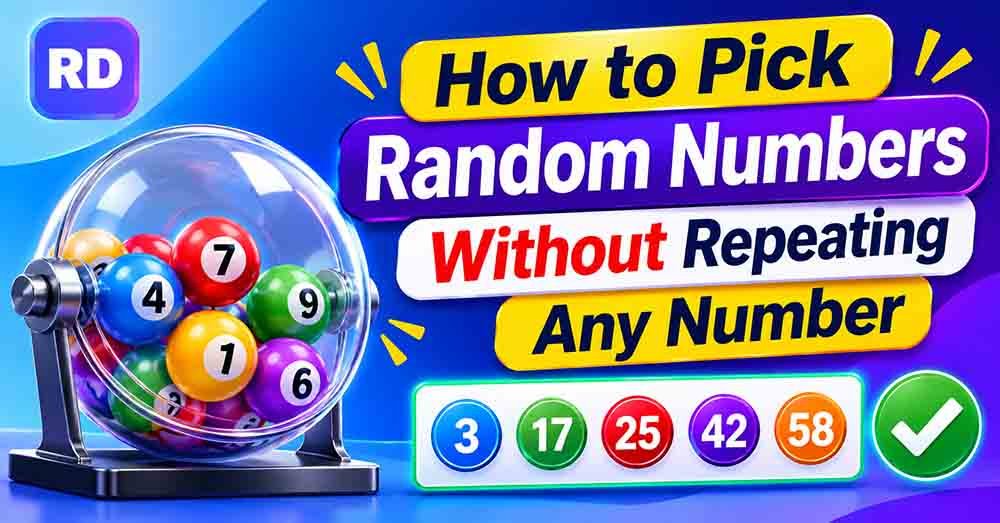
Random numbers without repeating are useful when you need to select different results without getting the same number twice. For example, you may want to pick five winners from fifty numbered tickets, create a random order for a game, or select unique participants for a competition. A no-repeat selection method makes sure every result is different.
Choosing numbers manually can take time, especially when you need many results. It can also lead to mistakes if you accidentally select the same number more than once. A random number generator can make this process easier by helping you choose numbers from a selected range.
This guide explains how non-repeating random numbers work, how they differ from normal random selections, and how to create a unique list from a number range. You will also learn about probability, common mistakes, and practical examples. You can follow along using the free Random Number Generator on RandomsDex.
What Are Non-Repeating Random Numbers?
Non-repeating random numbers are numbers selected randomly where each number can appear only once in the final result. This method is also known as unique random number selection.
For example, suppose you need five different numbers between 1 and 20. A valid result could be 3, 8, 12, 16, and 19. However, a result such as 3, 8, 12, 8, and 19 would not be valid because the number 8 appears twice.
The main purpose of this method is to prevent duplicate results while keeping the selection random.
Unique Number Selection
Imagine a bag containing numbered balls. You pick one ball and keep it outside the bag. When you select the next ball, the first one is no longer available.
This process makes sure that the same ball cannot be selected twice. A random number selection without repeats works in a similar way.
For example, if a bag contains numbers from 1 to 10, the first selection could be 4. After removing 4, the next selection can only come from the remaining nine numbers.
This process continues until you have selected the required number of unique results.
Random Sampling Without Replacement
In statistics, this method is called sampling without replacement. Replacement means putting an item back into the original group after selecting it.
Without replacement, the selected item stays outside the group. Therefore, the available pool becomes smaller after every selection.
This approach is commonly used in surveys, research, experiments, and prize draws where every selected item must be different.
Random Numbers With Repeats vs Without Repeats
Both methods produce random results, but they work differently. Choosing the right method depends on what you want to achieve. “random numbers without repeating”
Understanding this difference can help you avoid duplicate numbers and choose the correct settings before starting a selection.
Random Numbers With Replacement
When repeats are allowed, every selection comes from the full number range. Each selection is independent of the previous one. “random numbers without repeating”
For example, if you generate numbers between 1 and 10, the result could be 4, 7, 4, 9, and 4. This is perfectly normal when repeats are allowed.
This method is suitable for activities such as repeated dice rolls, lottery simulations, and games where the same result can appear more than once.
Random Numbers Without Replacement
When repeats are not allowed, every selected number is removed from the available pool. This means that a number cannot appear again in the same selection.
For example, if your first result is 6, the next result must be a different number. The generator can still select 1, 2, 3, 4, 5, 7, 8, 9, or 10.
This method is better for selecting multiple winners, creating unique lists, and organizing participants.
Number Selection Comparison
| Feature | With Repeats | Without Repeats |
|---|---|---|
| Can a number appear twice? | Yes | No |
| Pool size during selections | Stays the same | Shrinks each time |
| Good for | Dice rolls, repeated games | Winners, samples, turn order |
| Maximum results | Unlimited | Cannot exceed range size |
| Selection process | Independent draws | Draws without replacement |
For a basic explanation of minimum and maximum values, read our guide on how to generate random numbers between two numbers.
How to Generate Unique Numbers From a Range
Generating unique numbers is simple when you follow a clear process. First, decide how many numbers you need and select a range that contains enough numbers.
A larger range gives you more available choices. However, the number of results you request must never exceed the number of available values. “random numbers without repeating”
Generate Unique Random Numbers
Follow these steps:
- Decide your number range, such as 1 to 50.
- Choose how many unique numbers you need, such as 5.
- Open the Random Number Generator and enter your minimum and maximum values.
- If your selected tool provides a no-repeat or unique-number option, enable it.
- If no such option is available, generate one number at a time. Skip any number you have already selected and generate another result.
- Continue until you have collected the required number of different results.
- Check your final list to make sure there are no duplicates.
Always check the available settings of your chosen tool before starting.
Random Number List
Keeping a written list makes it easier to track your selections and avoid duplicates.
For example, if you need five unique numbers, your list might look like this:
- Pick 1: 23
- Pick 2: 8
- Pick 3: 41
- Pick 4: 16
- Pick 5: 35
Every number is different, so the final list contains five unique results.
A random number list is especially useful when you need to organize several selections. You can copy the results into a spreadsheet, write them in a notebook, or share them with other participants.
This manual method takes a little more time, but it can work with any generator that produces individual numbers.
Example of Selecting Five Numbers From 1 to 50
Let’s understand the process with a practical example. Suppose you want to select five different numbers from a range of 1 to 50.
This could be a small prize draw where every ticket has a unique number. Your goal is to select five winners without choosing the same ticket twice.
Five Unique Random Numbers
When selecting numbers without replacement, the number of available choices decreases after every selection.
- First pick: 50 possible numbers.
- Second pick: 49 remaining numbers.
- Third pick: 48 remaining numbers.
- Fourth pick: 47 remaining numbers.
- Fifth pick: 46 remaining numbers.
The total number of possible ordered results is:
50 × 49 × 48 × 47 × 46 = 254,251,200
If the order does not matter, such as selecting five raffle winners, divide this number by the 120 possible arrangements of five selected numbers.
50 × 49 × 48 × 47 × 46 ÷ 120 = 2,118,760
This means there are 2,118,760 different possible groups of five numbers.
Random Number Range Example
Each number from 1 to 50 has an equal chance of appearing in the final group of five. The probability for any particular number is:
5 ÷ 50 × 100 = 10%
Now compare this with a selection where repeats are allowed.
The chance that five independent selections from 1 to 50 are all different is:
254,251,200 ÷ 312,500,000 × 100 = 81.36%
Therefore, there is approximately an 18.64% chance of getting at least one repeated number when repeats are allowed.
This example shows why a no-repeat selection method is useful when every result must be unique.
How to Calculate the Number of Unique Combinations
Probability and combinations help explain how many different groups you can create from a selected range. “random numbers without repeating”
When you choose numbers without repeating them, the total number of possible combinations depends on two things: the size of the range and how many numbers you want to select.
The combination formula is:
C(n, r) = n! ÷ [r! × (n − r)!]
Here:
- n means the total number of available numbers.
- r means the number of selections you need.
- ! means factorial, which is the product of all positive whole numbers up to that value.
For example, if you choose three numbers from a range of five, the calculation is:
C(5, 3) = 5! ÷ (3! × 2!) = 10
This means you can create ten different groups of three numbers from a range of five.
The formula is useful when planning competitions, selecting samples, and understanding how many unique results are possible. “random numbers without repeating”
How to Check Whether a Number Range Is Large Enough
There is one important rule when selecting unique random numbers: you cannot select more different numbers than the range contains.
Before generating your list, calculate the total number of available values. This helps you avoid errors and unnecessary attempts.
Unique Number Range
Use this formula to calculate the total number of available whole numbers:
Count = Maximum − Minimum + 1
For example, a range from 10 to 30 contains:
30 − 10 + 1 = 21 numbers
Here are some more examples:
| Range | Total Numbers | Can You Pick 10 Unique Numbers? |
|---|---|---|
| 1 to 8 | 8 | No |
| 1 to 10 | 10 | Yes |
| 1 to 50 | 50 | Yes |
| 20 to 30 | 11 | Yes |
| 100 to 150 | 51 | Yes |
Number Selection Limits
If you request 10 unique numbers from a range of 1 to 8, the selection is impossible because only eight different numbers are available.
A generator may show an error or return fewer results if it cannot complete the request.
Always make sure your number range is large enough for the number of selections you need. If your activity allows it, choosing a larger range can give you more flexibility.
Common Mistakes When Picking Random Numbers Without Repeating
Even though unique number selection is simple, a few common mistakes can affect the results.
Choosing Too Many Numbers
One common mistake is requesting more unique numbers than the selected range contains.
For example, you cannot select 15 different numbers from a range of 1 to 10. Always calculate the range size before starting. “random numbers without repeating”
Forgetting to Check Previous Results
If you generate numbers individually, you must keep track of earlier selections. Otherwise, you may accidentally include a duplicate in your final list.
A simple written list or spreadsheet can help prevent this problem.
Confusing Randomness With Equal Results
A random selection does not mean that every number must appear the same number of times. In a no-repeat draw, every number has an equal chance of selection, but the final results will naturally be different. “random numbers without repeating”
Do not change valid random results simply because they do not look balanced or evenly distributed.
Using the Wrong Selection Method
Some activities allow repeated results, while others require unique results. Using a normal random generator without checking its repeat settings may create duplicates.
Choose a no-repeat method whenever every selected number must be different.
Where Unique Random Numbers Are Useful
Non-repeating random numbers are helpful in many everyday activities. They make it easier to select different participants, organize groups, and avoid duplicate results.
Here are some common uses:
- Giveaways and prize draws: Each numbered ticket should have a chance to win only once. Learn more in our guide on how to run a fair online lucky draw.
- Assigning tasks: Give each person a unique number to create a random work order. See how to randomly assign tasks to team members.
- Games: Select unique turn orders or secret numbers. Read how to use a random number generator for games.
- Learning probability: Compare different selection methods using simple probability formulas and examples.
- Classroom activities: Select different students or questions without choosing the same entry twice.
- Survey research: Choose a sample of different participants from a larger group.
- Team selection: Create different groups or assign unique positions during activities.
If you are unsure which type of tool is suitable for your activity, our guide on random number generator vs random number picker explains the difference.
Tips for Getting Fair and Reliable Random Results
A fair selection should give every eligible number an equal opportunity to be selected. The method should also prevent duplicate results when uniqueness is required.
Here are a few useful tips:
- Set clear rules: Decide how many numbers you need and whether repeats are allowed before starting.
- Use a suitable range: Make sure the minimum and maximum values cover all eligible numbers.
- Avoid manual preferences: Do not remove or change a valid result just because you do not like the number.
- Keep a record: Write down every selection to make the process easier to review.
- Check the final list: Confirm that every number is different before announcing the results.
- Use a suitable tool: Choose a generator that supports your required selection method.
For prize draws, it is also helpful to explain the selection rules before the draw begins. This makes the process easier for participants to understand and trust.
Frequently Asked Questions
1. How do I generate random numbers without repeats?
Set your minimum and maximum values, then use a unique-number option if your generator provides one. Otherwise, generate numbers individually and skip any result that has already appeared.
2. What is sampling without replacement?
Sampling without replacement means keeping each selected item outside the original group. This ensures that the same item cannot be selected again.
3. Can I pick more unique numbers than the range holds?
No. If your range contains eight different numbers, you can select a maximum of eight unique numbers.
4. Is each number equally likely to be selected?
Yes. In a fair random selection without replacement, every available number has an equal chance of being selected at each step. Before selection, each number also has an equal chance of appearing in the final group when the selection process is fair.
5. Why do repeats happen in normal random draws?
Repeats happen because the full number range remains available after every selection. When repeats are allowed, the same number can appear again by chance.
6. What is the difference between unique numbers and random numbers?
Random numbers can include repeated results, depending on the selection method. Unique random numbers are selected without duplicates, meaning each number appears only once in the final list.
7. Can I generate 10 unique numbers between 1 and 100?
Yes. A range from 1 to 100 contains 100 different numbers, so selecting 10 unique numbers is possible.
8. Are random numbers without replacement better for giveaways?
They are useful when each ticket or participant should be selected only once. This prevents the same entry from winning multiple times in a single draw.
Conclusion
Non-repeating random numbers are useful whenever you need different results without duplicate selections. Choose a range that is large enough, decide how many numbers you need, and use a no-repeat method to keep every result unique. “random numbers without repeating”
Understanding sampling without replacement, probability, and number range limits can help you make better selections. You can use this method for giveaways, prize draws, games, classroom activities, surveys, and team assignments.
Try the free Random Number Generator on RandomsDex to get started. For additional information about sampling with and without replacement, explore the OpenStax introduction to data sampling.