Generating random numbers between two numbers is an easy way to select numbers without choosing them manually. You may need to pick a winner from numbered tickets, decide who goes first in a game, or choose a number between 1 and 100 for a classroom quiz. A random number generator makes this process quick and simple. Just enter your minimum and maximum values to get a random result.
This guide walks you through how random number ranges work, how to set your minimum and maximum values and how to generate either a single number or a series of numbers. You can give it a go using the free Random Number Generator on RandomsDex.
What is a Random Number Range?
A random number range is the set of numbers that a generator can pick from. It has two values: a minimum and a maximum.
Random Number Range Meaning
For instance if you set a range from 1 to 10 the generator can pick any whole number in that range. It could return 1, 5, 8 or 10. It could not return 0 or 11.
Minimum and Maximum Numbers
A tool for generating random numbers between two numbers lets you choose any number within your selected minimum and maximum values. For example, if you select 5 as the minimum and 50 as the maximum, the generator can return any whole number within that range.
The minimum is the lowest number allowed, the maximum is the highest number allowed. Most standard random number generators will include both the min and the max in the range you specify.
For example a range of 1 to 10 includes both 1 and 10. That’s important when you’re picking numbers for a game, a quiz, a raffle etc.
Understanding Minimum and Maximum Values
The size of your selected range will determine how many possible results there are. If every whole number in that range has an equal chance of being selected then the number of possible results will also determine the probability of any one result occurring.
Min Max Random Number Generator
To calculate how many whole numbers are available in a range, use this simple formula:
Count = Maximum − Minimum + 1
The extra 1 is significant as both the min and the max are included.
Number Range Example
| Range | Count | Chance of One Specific Number |
|---|---|---|
| 1 to 10 | 10 | 10% |
| 1 to 100 | 100 | 1% |
| 5 to 15 | 11 | About 9.09% |
| 10 to 20 | 11 | About 9.09% |
| 1 to 6 (a dice) | 6 | About 16.67% |
Notice that a range from 5 to 15 contains 11 numbers not 10. A lot of people fail to add 1 when working out how many numbers are in a range. That little error can have a big impact on your probability calculations.
How to Generate Numbers Within a Range
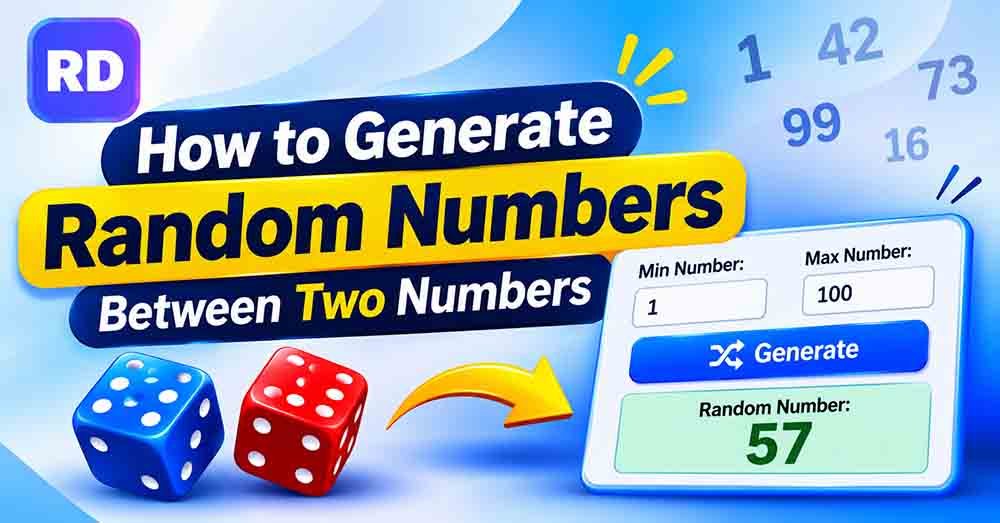
Generate a random number is simple really. You just enter the lowest and highest values and the tool will pick a result for you.
Random Number Generator Online
Follow these simple steps:
- Open the Random Number Generator.
- Enter your minimum number.
- Enter your maximum number.
- Start the generator and have a look at the result.
The selected number should be within your chosen range.
Generate Number Between 1 and 100
Suppose you want to generate a number between 1 and 100. Every number has an equal 1 in 100 chance of occurring so the probability of any one number is 1%.
You can also calculate the chances of getting a particular group of numbers:
- The numbers 1 to 50 have a combined probability of 50%.
- The numbers from 1 to 25 have a combined probability of 25%.
- The multiples of 10 have a combined probability of 10%.
Always ensure your minimum value is less than your maximum value. Some tools will in fact give an error if you’ve got the values the wrong way around. Whole numbers are the default option, although you may have the option of using decimal values depending on the settings available.
Generate One Number or Multiple Numbers
Sometimes you just need one result. Other times you may want a full list of random numbers. The right choice will depend on what you’re trying to achieve.
Multiple Random Numbers
For a single result (e.g. picking a single raffle winner) you’d just generate one number. If you need five numbers for a game or whatever then you can either generate them individually or use the multiple number option if your tool allows you to.
Always check whether the generator permits duplicate results or whether it gives you unique numbers.
Random Number List Generator
A random number list can be useful for several everyday activities, including:
- Selecting multiple winners from the numbered entries.
- Creating a random order for the turns.
- Select a sample question from the list of numbered questions.
- Assigning participants random numbers.
If your entries are names rather than numbers then a name selection tool may be more appropriate. Have a read of our guide on how to run a fair online lucky draw for some useful tips. You might also be interested in how to randomly assign tasks to team members.
Random Numbers With and Without Repeats
When you’re generating multiple results you need to decide whether the same number can appear more than once. That setting makes a massive difference.
Unique Random Numbers
Without repeats means that each of the numbers you select must be different. With repeats you can have the same number appearing more than once.
Take the example of picking three numbers from 1 to 10.
- With repeats: there are 10 × 10 × 10 = 1,000 possible ordered results. A result such as 4, 4, 9 is allowed.
- Without repeats: there are 10 x 9 x 8 = 720 possible ordered results. All the numbers must be different.
So if we’re selecting three numbers independently with repetition allowed, the probability that all three are different is 720/1,000 = 72%.
This also means there’s a 28% chance of getting at least one repeated number.
Random Numbers Without Duplicates
If you’re picking raffle winners or creating a list of unique numbers then duplicates can be an issue. In those circumstances it’s generally preferable to pick the numbers without any repeats.
Read our complete guide on how to pick random numbers without repeating any number to find out exactly how it works step by step.
Where Random Numbers Are Useful
Random numbers are useful in a whole host of everyday situations. They can be used to make fair selections, to organise things, to understand probability and so on.
Here are some common examples:
- Raffles and lucky draws: winners selected from numbered tickets.
- Games: playing number guessing games and board games. Learn more in our guide on how to use a random number generator for games.
- Surveys and quizzes: selecting the sample questions or the sample participants.
- Classroom activities: deciding the order of the presentations/turns.
- Learning maths: the basics of probability and number selection. Have a read of what probability is and some of the simple formulae and examples.
These are examples of why a random number generator can be of use for both personal and educational purposes.
A Note on Randomness
A random number generator is designed to produce results with no pattern whatsoever. You can occasionally see a repeat or some very odd run of numbers in a short sequence of results and that’s absolutely normal.
For example, with two rolls of a fair six sided die the probability of getting the same number both times is 6 in 36 i.e. approximately 16.67%.
A short streak doesn’t necessarily mean the generator is broken. It’s possible to get some very odd looking results even when each outcome is equally likely.
Frequently Asked Questions
1. How do I generate a random number between two numbers?**
Enter the lowest number as your minimum and the highest number as your maximum. Then press the generator to get a random result within your chosen range.
2. Are the min and max included?**
In the majority of random number generators yes. A range of 1 to 10 for instance could return either a 1 or a 10. If that’s important to your use case then you’ll need to check the tool description.
3. How many numbers are in a range?**
Subtract the minimum from the maximum and add 1. For example, 15 − 5 + 1 = 11. Therefore, a range from 5 to 15 contains 11 whole numbers.
4. Can I get the same random number twice?
Yes, if repeats are allowed. If you select a no-repeat option, each number can appear only once in your results.
5. Is a random number really unpredictable?
Random number generators are designed to produce results without a predictable pattern. For games, classroom activities, and everyday selections, ordinary random generators are usually suitable. However, do not use a casual generator for security purposes, such as creating passwords, unless it is specifically designed for secure random generation.
Conclusion
Generating a random number between two numbers is simple. Choose your minimum value, enter your maximum value, and let the generator select a result. Remember to add 1 when counting the total numbers in a range, and decide whether you want repeated or unique results.
For more technical detail on how computers generate random numbers, have a look at the NIST guidelines for random number generation.