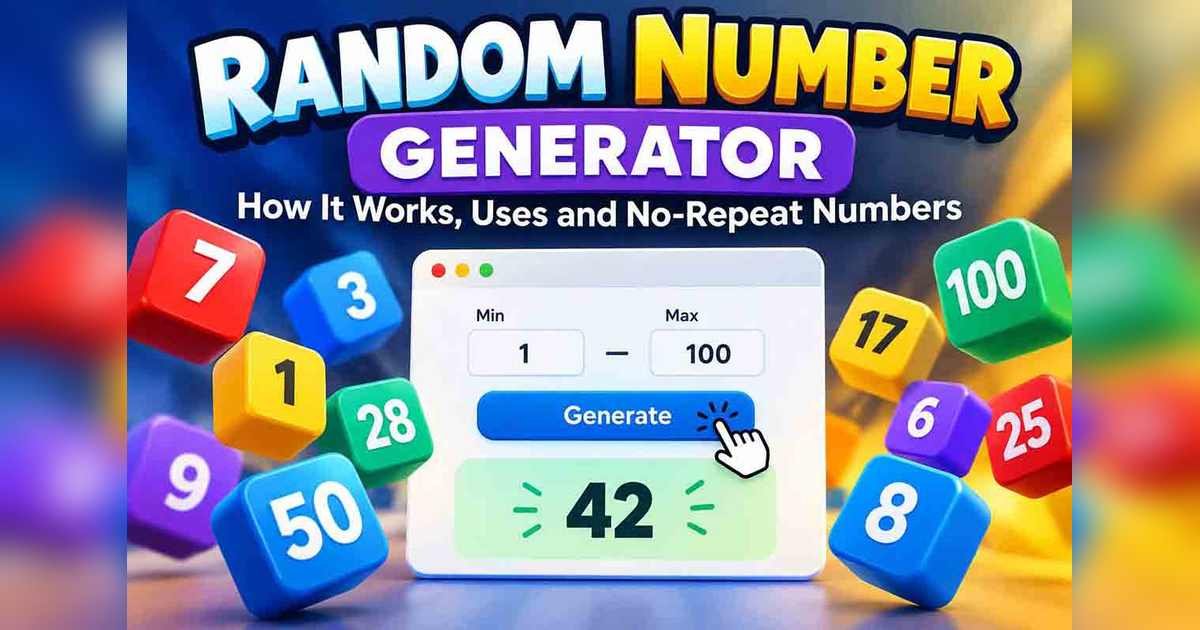
You need a number, and you want it to be fair. Maybe you are choosing a student to answer a question, deciding who goes first in a board game, or picking a raffle ticket. A random number generator does this job in one click, with no hidden bias and no arguments.
This guide explains what a random number generator is, how it works, and how to use it for a number between two values. It also covers multiple numbers, “no repeats” and the question many people ask: are computer-generated numbers truly random? You can try everything as you read with the free random number generator on RandomsDex.
What Is a Random Number Generator?
A random number generator (often called an RNG) is a tool that produces numbers that cannot be predicted ahead of time. You set a range, such as 1 to 100, and the tool gives you a number from that range.
In a fair generator, every number in the range has the same chance of being picked. In a range of 1 to 100, each number has a 1 in 100 chance, or 1%. The number 7 is no more likely than 93.
People also call these tools a random number picker, a number randomizer, or a tool to generate random numbers. They all describe the same idea.
How Does Random Number Generation Work?
Computers follow instructions, so they are not naturally random. Most online tools use a pseudo-random number generator, or PRNG. This is a formula that starts from a “seed” value and produces a long stream of numbers that look random and pass many statistical tests.
There are two main types of randomness:
- Pseudo-random: made by an algorithm. It is fast and works well for games, classrooms and general picking.
- True random: made from a physical process that is hard to predict. For example, RANDOM.ORG says its numbers come from atmospheric noise.
For security tasks, such as making passwords or encryption keys, ordinary pseudo-random code is not enough. Browsers offer a separate, cryptographically secure source for that. MDN, the web developer reference, warns that the common Math.random() function is not secure and should not be used for anything related to security. We cover this idea more in our guide on how random selection works.
How to Generate a Number Between Two Values
Choosing a number between two values is the most common use. You set a minimum and a maximum, and the generator picks a number inside that range.
Here is the basic idea:
- Decide your minimum (for example, 1).
- Decide your maximum (for example, 50).
- Run the generator once to get one number.
Check whether the range is inclusive. An inclusive range of 1 to 50 can return 1 or 50 or anything in between. The number of possible results is max − min + 1.
Example: How many outcomes are in the range 10 to 20?
20 − 10 + 1 = 11 possible numbers (10, 11, 12 … 20)
If you forget the “+ 1,” you will miscount the chances. This matters if you are working out probability for a game.
Random Number Generator 1–100
The 1 to 100 range is the most popular choice. It works well for:
- Picking a “percentage” style number for a game or challenge
- Guessing games and number-guessing contests
- Choosing a ticket number from a set of 100
- Quick decisions when you need many possible outcomes
Because the range has 100 numbers, each pick has a 1% chance. If you run it ten times, you may well see the same number twice. That does not mean the tool is broken. We explain why in the next section.
Generating Multiple Numbers
Sometimes one number is not enough. You might need five lottery-style picks, ten raffle winners, or a list of numbers for a classroom activity.
When you ask for several numbers, there are two possible rules:
- With repeats: every pick is separate, so the same number can appear more than once.
- Without repeats: once a number is picked, it is removed from the pool.
Which one you need depends on the task.
What Does “No Repeats” Mean?
“No repeats” (also called unique numbers, or selection without replacement) means each number can appear only once in your results.
Think of drawing numbered balls from a bag without putting them back. Once ball 17 is out, it cannot come out again.
Here is why this matters. If you pick 10 numbers from 1 to 10 with repeats, the chance that all ten are different is 10! ÷ 10¹⁰ = 3,628,800 ÷ 10,000,000,000, which is about 0.036%. Repeats are almost certain.
So if you are picking raffle winners, you should use a no-repeat setting. Otherwise one ticket could “win” twice.
Example: Pick 5 different numbers from 1 to 50.
The number of possible groups of 5 is 50 × 49 × 48 × 47 × 46 ÷ (5 × 4 × 3 × 2 × 1) = 254,251,200 ÷ 120 = 2,118,760.
Each group is equally likely.
Why You Should Not Trust “Patterns”
People often think a number is “due” because it has not appeared for a while. This is called the gambler’s fallacy. A fair generator has no memory. If 42 came up last time, the chance of 42 next time is still exactly the same.
Classroom Uses
A random number generator for the classroom saves time and keeps things fair. Teachers use it to:
- Give each student a number, then pick one to answer a question
- Choose the order for presentations
- Split a class into groups by picking numbers
- Select a question from a numbered list
- Run quick maths games, such as “guess the number between 1 and 20”
Students tend to accept the result more easily when the choice is clearly random and not the teacher’s preference.
If you would rather pick students by name, try a random name picker instead. It works on the same fair-selection idea, but uses names instead of numbers.
Game Uses
A random number picker for games can replace physical items you do not have to hand:
- Dice: use a range of 1 to 6 for one die, or run it twice for two dice.
- Turn order: give each player a number and let the generator decide who goes first.
- Board and party games: pick a card number, a challenge number or a prize.
- Role-playing games: use ranges such as 1 to 20 for a twenty-sided die.
Are Computer-Generated Numbers Truly Random?
Strictly speaking, no. Pseudo-random numbers come from a formula, so in theory they can be reproduced if you know the starting seed and the algorithm.
But for everyday use, this does not matter. A good generator produces numbers that are evenly spread and have no obvious pattern. For a classroom pick or a game of dice, that is more than enough.
It does matter in a few cases:
- Security: passwords, keys and tokens need a cryptographically secure source.
- Gambling and official lotteries: these are regulated and use approved systems.
- Scientific research: some studies need certified or physical randomness.
For those uses, choose a tool made for that purpose. For example, to make a secure password, use a password generator built for it, not a simple number picker.
How to Use the RandomsDex Random Number Generator
The RandomsDex Random Number Generator is free and runs in your browser. Here is the general process:
- Open the tool.
- Enter the lowest and highest number you want.
- If the tool lets you choose how many numbers to generate, set that amount.
- If you need every number to be different, look for the option that stops repeated numbers.
- Click the button to generate your result.
If you want to check a result, run it a few times. You should see different numbers each time, spread across the whole range.
Common Mistakes When Using a Random Number Generator
- Using the wrong range. If you have 28 students, use 1 to 28, not 1 to 30.
- Forgetting that the range is inclusive. Both ends can be picked.
- Allowing repeats when you need winners. Use no-repeat picks for raffles and prizes.
- Re-rolling until you like the answer. This defeats the purpose. Decide the rule before you generate.
- Using a basic picker for security. Use a proper password tool for that.
FAQs
How do I generate a random number between two numbers?
Set the lowest and highest values, then run the generator. A fair tool gives every number in that range an equal chance.
Can a random number generator repeat numbers?
Yes, if repeats are allowed. Each pick is independent, so the same number can come up again. Use a no-repeat or unique setting if you need different numbers every time.
Is a random number generator really fair?
For everyday use, yes. A good generator gives each number in the range the same chance. It does not favour any number and it does not remember past results.
What is the difference between pseudo-random and true random?
Pseudo-random numbers come from a mathematical formula. True random numbers come from a physical process, such as atmospheric noise. For games and classrooms, pseudo-random is fine.
Can I use a random number generator for a giveaway?
You can use it to pick a winner by number, for example by matching a number to an entry. Keep a record of how entries were numbered. Also check the rules that apply to giveaways where you live.
How many numbers can I pick from 1 to 100 without repeats?
You can pick up to 100, because there are only 100 different numbers in the range. Asking for more than 100 unique numbers is not possible.
Is a random number picker the same as a dice roller?
It can work like one. For a six-sided die, set the range to 1 to 6. For a twenty-sided die, use 1 to 20.
Conclusion
A random number generator is a simple way to make fair choices. Set your range, decide whether repeats are allowed, and let the tool do the work. For everyday tasks, it is quick, fair and easy.
Ready to pick your numbers? Try the free RandomsDex Random Number Generator.
Internal links used in this article
| Anchor text | Type | URL |
|---|---|---|
| random number generator | Tool | https://randomsdex.com/tools/random-number-generator/ |
| how random selection works | Article 9 | https://randomsdex.com/how-does-random-selection-work/ |
| random name picker | Article 3 | https://randomsdex.com/random-name-picker-how-to-pick-names-fairly/ |
| password generator | Article 5 | https://randomsdex.com/how-to-create-a-strong-password/ |
| RandomsDex Random Number Generator | Tool | https://randomsdex.com/tools/random-number-generator/ |
| RandomsDex Random Number Generator | Tool | https://randomsdex.com/tools/random-number-generator/ |
Sources and references
MDN Web Docs – Math.random() (notes that it is not cryptographically secure) https://developer.mozilla.org/en-US/docs/Web/JavaScript/Reference/Global_Objects/Math/random
MDN Web Docs – Crypto.getRandomValues() (secure random values in browsers) https://developer.mozilla.org/en-US/docs/Web/API/Crypto/getRandomValues
RANDOM.ORG – Introduction to Randomness and Random Numbers (atmospheric noise vs computer algorithms) https://www.random.org/randomness/
Combination and probability examples were recalculated by hand.