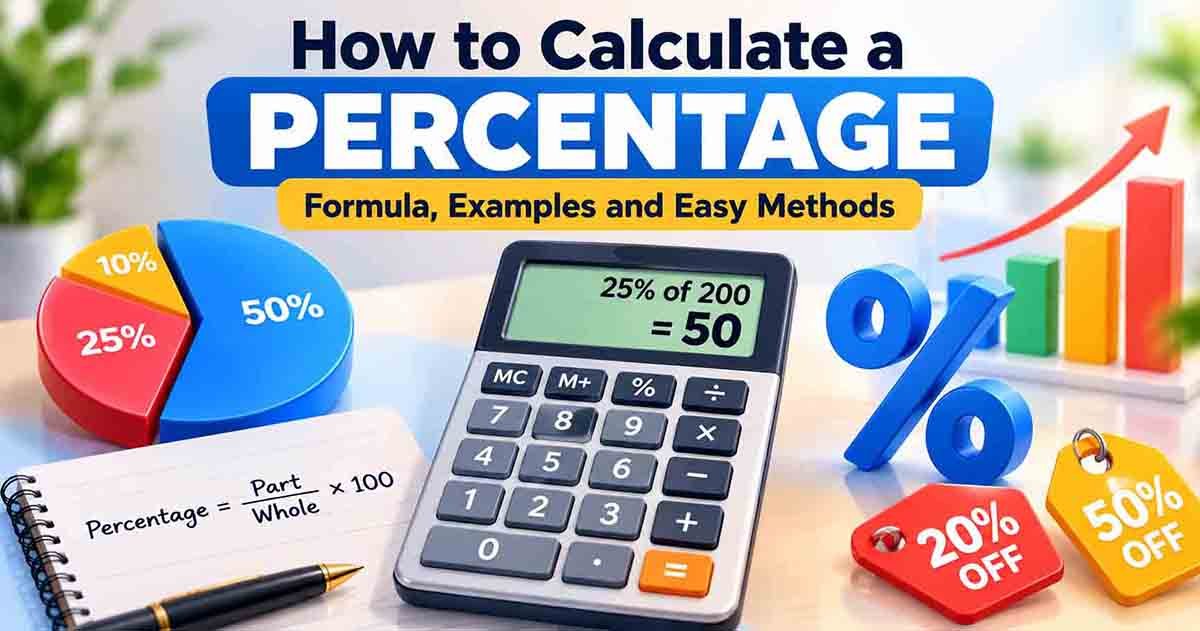
Percentages appear everywhere, from exam results and shopping discounts to taxes and salary increases. Learning how to calculate percentage helps you solve these everyday problems quickly and accurately.
If you want to learn how to calculate percentage step by step, this guide explains the basic formula, easy methods, and practical examples. You can also use the free RandomsDex Percentage Calculator to check your answers in seconds.
Whether you need to calculate percentage marks, find a discount, or work out a price increase, these simple methods will help you understand the process.
What Is a Percentage?
“Percent” means “per hundred.” So 25% means 25 out of every 100. You can also write it as the fraction 25/100 or the decimal 0.25.
Picture a pizza cut into 8 equal slices. If you eat 2 slices, you ate 2 out of 8. That is 2 ÷ 8 = 0.25, which is 25%.
Here are some common percentages in three forms:
| Percentage | Fraction | Decimal |
|---|---|---|
| 50% | 1/2 | 0.5 |
| 25% | 1/4 | 0.25 |
| 75% | 3/4 | 0.75 |
| 10% | 1/10 | 0.1 |
| 5% | 1/20 | 0.05 |
Knowing these by heart makes quick mental checks much easier.
The Basic Percentage Formula
Almost every percentage problem uses the same formula:
Percentage = (Part ÷ Whole) × 100
The part is the piece you are interested in. The whole is the total amount.
The formula can answer three kinds of questions:
- What is X% of a number?
- What percentage is one number of another number?
- By what percentage did something go up or down?
Let us take them one at a time.
How to Find a Percentage of a Number
Use this version of the formula when you know the percentage and the total, and you want the part.
Answer = (Percentage ÷ 100) × Number
Example 1: What is 20% of 150?
Step 1: Divide the percentage by 100. 20 ÷ 100 = 0.2
Step 2: Multiply by the number. 0.2 × 150 = 30
Example 2: What is 8% of 250?
Step 1: 8 ÷ 100 = 0.08
Step 2: 0.08 × 250 = 20
A Quick Mental Shortcut
You can build many percentages from 10%, 5% and 1%:
- To find 10%, divide the number by 10.
- To find 5%, take half of the 10% value.
- To find 1%, divide the number by 100.
For example, to find 15% of 60: 10% of 60 is 6, and 5% is 3. Add them: 6 + 3 = 9.
How to Find What Percentage One Number Is of Another
This is the question “what percentage is one number of another?” Put the smaller piece on top and the total on the bottom.
Example: 45 is what percentage of 60?
Step 1: Divide the part by the whole. 45 ÷ 60 = 0.75
Step 2: Multiply by 100. 0.75 × 100 = 75%
Example: You answered 18 of 24 questions correctly.
18 ÷ 24 = 0.75, so your score is 75%.
A simple tip: the whole is usually the number that comes after the word “of.” In “45 is what percent of 60,” the whole is 60.
How to Calculate Percentage in Everyday Life
Learning how to calculate percentage is useful when comparing prices, checking exam results, or working out taxes.
If you are unsure how to calculate percentage, start by identifying the part and the whole before using the formula.
You can use the same method to learn how to calculate percentage for discounts, salary changes, and sales figures.
For quick results, practise how to calculate percentage with different numbers and check your answers using an online calculator.
Once you understand how to calculate percentage, you can solve many everyday maths problems more confidently.
Percentage Increase and Percentage Decrease
Percentage change tells you how much a value grew or shrank compared with its original value.
Percentage change = ((New value − Old value) ÷ Old value) × 100
If the answer is positive, it is an increase. If it is negative, it is a decrease.
Increase example: A price goes from 80 to 100.
Change = 100 − 80 = 20
20 ÷ 80 = 0.25
0.25 × 100 = 25% increase
Decrease example: A price goes from 200 to 150.
Change = 150 − 200 = −50
−50 ÷ 200 = −0.25
−0.25 × 100 = −25%, which is a 25% decrease
Notice that we always divide by the old value. That is the most common place people slip up. We explain this in more detail, with price, salary and sales examples, in our guide to percentage increase and decrease.
How to Calculate Percentage From Exam Marks
Exam percentages use the same “part ÷ whole × 100” formula.
Example: A student scores 432 out of 500.
432 ÷ 500 = 0.864
0.864 × 100 = 86.4%
When subjects have different totals, add the marks first and then divide.
| Subject | Marks Obtained | Total Marks |
|---|---|---|
| Maths | 68 | 80 |
| Science | 45 | 60 |
| English | 33 | 40 |
| Total | 146 | 180 |
146 ÷ 180 = 0.8111, so the overall result is about 81.1%.
Be careful here. If you find the percentage of each subject (85%, 75% and 82.5%) and then average them, you get 80.8%. That is a little different, because the subjects have different totals. Your school or board may have its own rule, so check which method it uses.
You can also work backwards. If you need 40% to pass a 150-mark paper, you need 0.4 × 150 = 60 marks.
How to Calculate a Percentage Discount
Shops use percentages all the time. Here is how to work out a sale price.
Example: A jacket costs $80 and has 25% off.
Discount = 25% of 80 = 0.25 × 80 = $20
Sale price = 80 − 20 = $60
There is a shortcut. If 25% is taken off, you pay the other 75%. So 0.75 × 80 = $60.
Finding the Original Price
Sometimes you know the sale price and want the original one. “calculate percentage”
Example: A shirt costs $60 after 25% off. What was the original price?
You paid 75% of the original price, so divide by 0.75.
60 ÷ 0.75 = $80
Two Discounts in a Row
Two discounts do not simply add together. Take 20% off $100, then another 10% off.
After 20% off: 100 × 0.8 = 80
After another 10% off: 80 × 0.9 = 72
The total saving is $28, not $30, because the second discount applies to a smaller price.
Percentages and Dates
Percentages also work with time. Suppose 73 days of a 365-day year have passed. That is 73 ÷ 365 = 0.2, or 20% of the year. “calculate percentage”
To do this you need an accurate count of days between two dates. Our guide on how to calculate age in years, months and days shows how to count dates correctly, including leap years.
Common Percentage Mistakes
Here are the errors we see most often:
- Using the wrong whole. In “what percent is 15 of 60,” the whole is 60, not 15.
- Forgetting to multiply by 100. Dividing 45 by 60 gives 0.75. You must multiply by 100 to get 75%.
- Mixing up percent and percentage points. If a rate rises from 10% to 15%, it went up by 5 percentage points. But it also rose by 50% compared with where it started, because 5 ÷ 10 = 0.5.
- Adding percentages that should be multiplied. A 20% discount followed by a 10% discount is not a 30% discount.
- Dividing by the new value. For percentage change, divide by the old value.
- Rounding too early. Keep extra decimals until the final step.
Using the RandomsDex Percentage Calculator
Doing the sums by hand is a great way to learn. But for everyday use, a calculator saves time and helps you catch mistakes. “calculate percentage”
The RandomsDex Percentage Calculator is free to use in your browser. Enter your numbers in the fields provided, then compare the result with your own working. If the two answers match, you can feel confident about it.
It is also handy for checking homework, working out discounts while shopping, or comparing prices. You can find other tools of this kind in the calculators category.
More Everyday Percentage Examples
Percentages help with small daily sums too.
Tip: What is a 15% tip on a $48 bill?
0.15 × 48 = $7.20, so the total is 48 + 7.20 = $55.20.
Sales tax: An item costs $50 and tax is 8%.
Tax = 0.08 × 50 = $4, so you pay $54.
Working backwards: You paid $54 with 8% tax included. What was the price before tax?
The total is 108% of the original price, so divide by 1.08.
54 ÷ 1.08 = $50
Whenever you see “including tax” or “after discount,” ask yourself which number is the whole. Then you will know whether to multiply or divide.
FAQs
What is the formula for percentage?
The basic formula is Percentage = (Part ÷ Whole) × 100. To find a percentage of a number, use (Percentage ÷ 100) × Number.
How do I calculate 10% of a number quickly?
Divide the number by 10. For example, 10% of 340 is 34. Move the decimal point one place to the left.
How do I calculate percentage without a calculator?
Break the percentage into easy pieces. For 15%, find 10% (divide by 10), find 5% (half of that), and add them together.
What is the difference between a percentage and a percentage point?
A percentage point is the plain gap between two percentages. Going from 40% to 45% is a rise of 5 percentage points. The same move is a 12.5% increase, because 5 ÷ 40 = 0.125.
Can a percentage be more than 100%?
Yes. If a value grows to more than double its starting point, the increase is over 100%. For example, going from 50 to 130 is a 160% increase: (130 − 50) ÷ 50 = 1.6.
How do I find the original number if I know the percentage?
Divide the known amount by the percentage written as a decimal. If 30 is 20% of a number, then 30 ÷ 0.2 = 150.
How do I turn a fraction into a percentage?
Divide the top number by the bottom number, then multiply by 100. For 3/8: 3 ÷ 8 = 0.375, so the answer is 37.5%.
Conclusion
A percentage is just a part compared with a whole, scaled to 100. Once you know the main formula and the three question types, most problems become easy. Practise with small numbers first, then check bigger ones with a tool.
Need the result without doing the calculation manually? Try the free RandomsDex Percentage Calculator.
Sources and References
Khan Academy – Percentages (educational reference for the percent concept and formulas)



Comments