A shop says prices went up by 20%. Your salary rises by 5%. Sales fall by 12%. Each of these is an example of percentage increase vs decrease, and each one compares a new value with an old one.
Understanding percentage increase and decrease helps you calculate changes in prices, salaries, sales and other everyday numbers.
This guide explains the percentage increase formula, percentage decrease formula and step-by-step examples. You’ll also learn about 7 common mistakes and why a 25% rise followed by a 25% fall does not bring you back to the starting value.
If you want quick answers, use the free RandomsDex Percentage Calculator.
What Is Percentage Change?
Percentage change shows how much a value has increased or decreased compared with its original value.
The word original matters. It is always the starting point, also called the old value or the base.
- If the new value is higher than the old one, you have a percentage increase.
- If the new value is lower, you have a percentage decrease.
You can use the same formula for both:
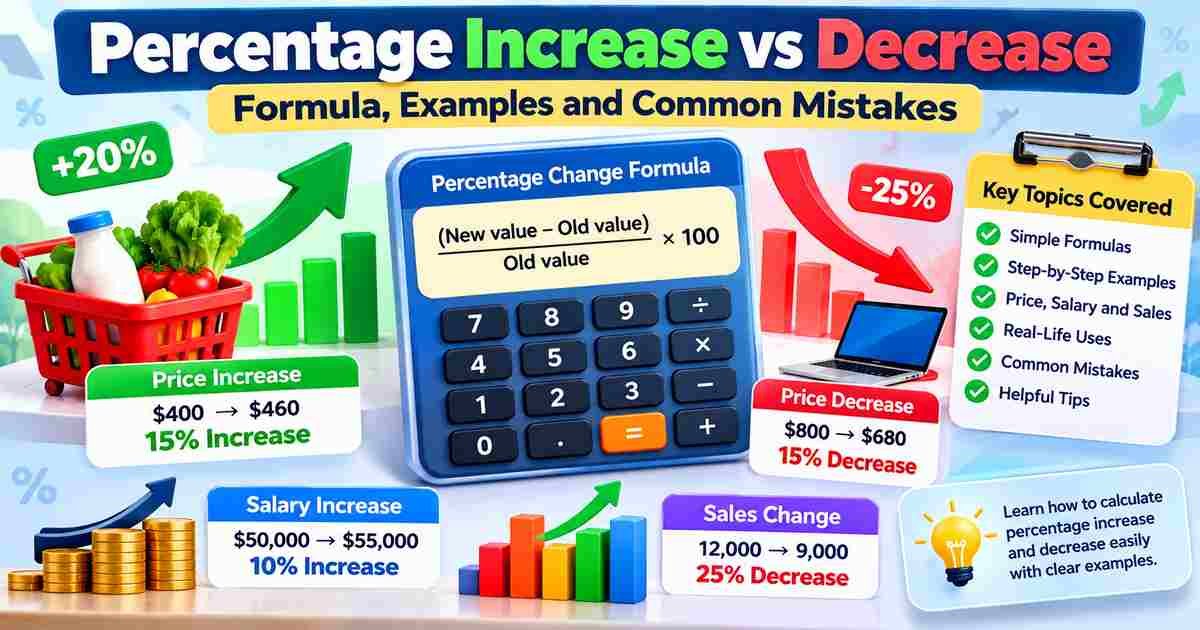
Percentage Change = ((New Value − Old Value) ÷ Old Value) × 100
A positive answer means an increase. A negative answer means a decrease.
If you are new to percentages in general, start with our guide on how to calculate a percentage.
Percentage Increase Formula
When the new value is larger, use this percentage increase formula:
Percentage Increase = ((New − Old) ÷ Old) × 100
How to Calculate Percentage Increase
Follow these three steps:
- Subtract the old value from the new value to find the increase.
- Divide the increase by the old value.
- Multiply by 100 and add the % sign.
Example: Percentage Increase From $400 to $460
A phone costs $400 last year and $460 this year.
Step 1: 460 − 400 = 60
Step 2: 60 ÷ 400 = 0.15
Step 3: 0.15 × 100 = 15%
Answer: 15% increase
This method works for price increases, salary raises, sales growth and other positive changes.
Percentage Decrease Formula
When the new value is smaller, use the percentage decrease formula:
Percentage Decrease = ((Old − New) ÷ Old) × 100
How to Calculate Percentage Decrease
- Subtract the new value from the old value.
- Divide the difference by the old value.
- Multiply by 100.
Example: Percentage Decrease From $800 to $680
A laptop costs $800 and is reduced to $680.
Step 1: 800 − 680 = 120
Step 2: 120 ÷ 800 = 0.15
Step 3: 0.15 × 100 = 15%
Answer: 15% decrease
Notice that both percentage increase and percentage decrease formulas divide by the old value.
This is the most important rule to remember.
Percentage Change Between Two Numbers
You can calculate percentage change between two numbers using the same method.
Always use the starting number as the old value and the ending number as the new value.
Example 1: From 50 to 40
(40 − 50) ÷ 50 = −10 ÷ 50 = −0.2
−0.2 × 100 = −20%
Answer: 20% decrease
Example 2: From 40 to 50
(50 − 40) ÷ 40 = 10 ÷ 40 = 0.25
0.25 × 100 = 25%
Answer: 25% increase
The difference between the numbers is 10 in both examples.
However, the percentage changes are different because the starting values are different.
Tip: Always check which number is the original value before calculating.
Worked Examples of Percentage Increase and Decrease
Let’s look at some real-life percentage increase and decrease examples involving prices, salaries and sales.
1. Price Changes
Example 1: A bag of rice goes from $12.00 to $13.50.
13.50 − 12.00 = 1.50
1.50 ÷ 12 = 0.125
0.125 × 100 = 12.5%
Answer: 12.5% increase
Example 2: A jacket falls from $120 to $90.
90 − 120 = −30
−30 ÷ 120 = −0.25
Answer: 25% decrease
2. Salary Changes
Example: A salary rises from 50,000 to 55,000 a year.
55,000 − 50,000 = 5,000
5,000 ÷ 50,000 = 0.1
Answer: 10% increase
You can also calculate a new salary when you already know the percentage raise.
If you get a 6% raise on a 40,000 salary:
0.06 × 40,000 = 2,400
New salary = 40,000 + 2,400
Answer: 42,400
3. Sales Changes
Example 1: Monthly sales drop from 12,000 to 9,000.
9,000 − 12,000 = −3,000
−3,000 ÷ 12,000 = −0.25
Answer: 25% decrease
Example 2: Sales then climb from 9,000 to 10,800.
10,800 − 9,000 = 1,800
1,800 ÷ 9,000 = 0.2
Answer: 20% increase
Notice that sales increased by 20% after falling by 25%, but the final value was still below the original 12,000.
This happens because each percentage change uses a different starting value.
Everyday Example: Percentage Change in Word Count
Percentage change is not only useful for money.
Suppose you shorten an essay from 1,200 words to 900 words.
(900 − 1,200) ÷ 1,200 = −300 ÷ 1,200 = −0.25
Answer: 25% decrease in word count
You can check both word counts using our Word Counter Guide and then apply the percentage change formula.
How to Find the New Value From a Percentage
Sometimes you already know the percentage increase or decrease and want to calculate the new value.
You can use these formulas.
Percentage Increase: New Value Formula
New Value = Old Value × (1 + Percentage ÷ 100)
Example: Increase 80 by 15%.
80 × 1.15 = 92
Answer: 92
Percentage Decrease: New Value Formula
New Value = Old Value × (1 − Percentage ÷ 100)
Example: Decrease 250 by 20%.
250 × 0.80 = 200
Answer: 200
These formulas are also useful for checking answers from percentage change calculations.
Why Equal Percentage Increases and Decreases Do Not Cancel Out
One common mistake is thinking that a 10% increase followed by a 10% decrease returns a number to its original value.
It does not.
Example: 10% Increase Followed by 10% Decrease
Start with 100.
Increase by 10%:
100 × 1.10 = 110
Decrease by 10%:
110 × 0.90 = 99
Final value: 99, not 100
The reason is simple.
The 10% increase is calculated from 100, while the 10% decrease is calculated from 110.
Example: 50% Increase Followed by 50% Decrease
Start with 100.
Increase by 50%:
100 × 1.50 = 150
Decrease by 50%:
150 × 0.50 = 75
Final value: 75
This is why equal percentage increases and decreases do not cancel each other out.
What Percentage Increase Is Needed to Recover a Decrease?
When a value falls, it needs a larger percentage increase to return to its original value.
Example: Recovering From a 25% Increase
A price rises from 80 to 100.
This is a 25% increase.
To return to 80:
(100 − 80) ÷ 100 = 0.20
Answer: 20% decrease
Similarly, recovering from a 20% decrease requires a 25% increase.
Percentage Recovery Table
| Percentage Decrease | Increase Needed to Recover |
|---|---|
| 10% | 11.1% |
| 20% | 25% |
| 25% | 33.3% |
| 50% | 100% |
This is especially useful when understanding stock prices, investments and business sales.
Special Cases in Percentage Change
Doubling and Halving
If a value doubles, it represents a 100% increase.
If a value halves, it represents a 50% decrease.
Starting From Zero
If the old value is zero, the percentage change formula would require division by zero.
Therefore, the percentage change is undefined.
In this situation, describe the change using actual numbers instead.
Negative Numbers
Percentage change calculations can become confusing when the original value is negative.
Finance and science sometimes use different methods for these situations.
Always explain which method you are using.
Percentage Points vs Percentage Change
If a rate increases from 10% to 12%, the difference is 2 percentage points.
However, the relative percentage increase is:
2 ÷ 10 × 100 = 20%
Answer: 20% increase, or 2 percentage points
These two measurements are not the same.
7 Common Percentage Increase and Decrease Mistakes
When using a percentage increase or decrease formula, avoid these seven common mistakes.
1. Dividing by the New Value
Always divide by the old value, not the new value.
The old value is the starting point for the calculation.
2. Swapping Old and New Values
Going from 40 to 50 is a 25% increase.
Going from 50 to 40 is a 20% decrease.
The direction matters.
3. Thinking Equal Increases and Decreases Cancel Out
A 10% increase followed by a 10% decrease does not return a value to its starting point.
For example, 100 becomes 110 and then 99.
4. Adding Percentage Changes Over Several Periods
A 10% increase followed by a 20% increase is not a 30% total increase.
Instead:
1.10 × 1.20 = 1.32
Answer: 32% increase
5. Confusing Percent and Percentage Points
Percentage change is relative to the original value.
Percentage points measure the difference between two percentage values.
6. Forgetting the Negative Sign
A negative percentage change means a decrease.
Write “decrease” clearly to avoid confusion.
7. Rounding Too Soon
Keep decimal values during your calculations.
Round the final answer only after completing the formula.
How to Use the RandomsDex Percentage Calculator
You can use the free RandomsDex Percentage Calculator to check percentage changes quickly.
Follow these simple steps:
- Open the calculator and enter the old and new values.
- Check the result to see whether it shows an increase or decrease.
- Compare the answer with your manual calculation.
This is useful when checking price changes, salary offers, sales figures and everyday percentage problems.
Frequently Asked Questions (FAQs)
How Do I Calculate Percentage Increase?
Subtract the old value from the new value, divide by the old value and multiply by 100.
For example:
(100 − 80) ÷ 80 × 100 = 25% increase
How Do I Calculate Percentage Decrease?
Subtract the new value from the old value, divide by the old value and multiply by 100.
For example:
(200 − 150) ÷ 200 × 100 = 25% decrease
What Is the Percentage Change Formula?
The formula is:
Percentage Change = ((New − Old) ÷ Old) × 100
A positive result means an increase, while a negative result means a decrease.
Why Does a 10% Increase Followed by a 10% Decrease Not Return to the Original Value?
Because the second percentage is calculated from a different value.
Starting at 100, a 10% increase gives 110.
A 10% decrease from 110 gives 99, not 100.
Can a Percentage Increase Be More Than 100%?
Yes.
If a value more than doubles, the percentage increase is greater than 100%.
For example, increasing from 20 to 70 is a 250% increase.
Can a Percentage Decrease Be More Than 100%?
Not for normal positive quantities that cannot go below zero.
A 100% decrease means the value falls to zero.
What Is the Difference Between Percentage Change and Percentage Difference?
Percentage change compares a new value with an original value.
Percentage difference compares two values when neither is the starting point. It often uses their average as the base.
Use percentage change for before-and-after calculations.
Conclusion
Understanding percentage increase vs decrease makes it easier to calculate changes in prices, salaries, sales and everyday numbers.
The formula is simple:
Subtract, divide by the old value and multiply by 100.
Always identify the correct starting value and remember that equal percentage increases and decreases do not cancel each other out.
Avoid the 7 common mistakes explained above and double-check your calculations before using the results.
For faster calculations, try the free RandomsDex Percentage Calculator.
Sources and References
All numerical examples use the standard percentage change formula: ((New − Old) ÷ Old) × 100.