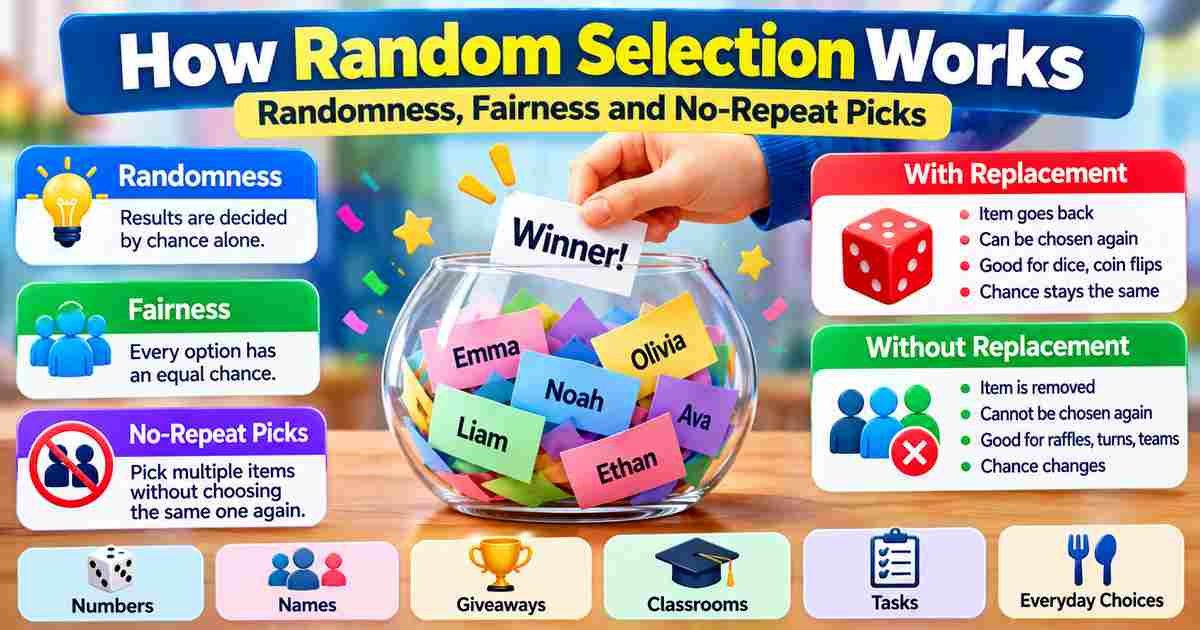
How random selection works is simple: every option gets a fair chance of being chosen. Whether you’re selecting students, giveaway winners or everyday choices, random selection helps you make decisions based on chance rather than personal preference.
In this guide, you’ll learn how random selection works, what makes a random pick fair, the difference between selection with and without replacement, and why no-repeat picks matter.
You can also try the free RandomsDex Random Number Generator and RandomsDex Random Name Picker to make random selections easily.
What Is Random Selection?
Random selection means choosing an item from a group so that the result is decided by chance alone. Nobody’s opinion, order in the list or mood affects it.
You see it in everyday life:
- Drawing a name from a hat
- Rolling a die
- Flipping a coin
- Drawing a raffle ticket
- Using a random choice generator or random picker on a website
The goal is the same in every case: give each option a fair chance.
How Does Random Selection Work?
Think of it in three steps.
Step 1: List the options. Write down every item that could be picked. This can be names, numbers or choices.
Step 2: Give each option a position. In a list of 10 items, the positions are 1 to 10.
Step 3: Pick a random position. A random number chooses one position, and the item in that position is your result.
For example, imagine a list of 10 names. A random number generator picks a number from 1 to 10. If it picks 4, the fourth name is selected. Each name had a 1 in 10 chance, or 10%.
Computers do step 3 with a random number generator. That is why the quality of the generator matters, and we will come back to it below.
What Makes a Random Pick Fair?
A pick is fair when these conditions are true:
- Equal chance. Every option has the same chance of being chosen, unless you have deliberately set different weights.
- Independence. One pick does not change the chances of the next, except when you remove items on purpose.
- A complete and correct list. Everyone who should be in the draw is on the list once.
- A rule set in advance. You decide how many items to pick and whether repeats are allowed before you press the button.
- No re-draws. You accept the result. Re-drawing until you like it is not random.
- Transparency. People can see the list and the process, if that matters for trust.
Fair does not mean “evenly spread.” Real random results often look clumpy. You might see the same name twice in a row. That alone does not show a problem.
Selection With Replacement
In selection with replacement, an item goes back into the pool after it is picked. It can be chosen again.
Think of drawing a card, writing it down, then putting it back and shuffling. Every draw starts with the same full deck.
Rolling a die is a good example. Getting a 6 now does not stop you from getting another 6 next time.
Use selection with replacement when:
- Each pick is a separate event (dice, coin flips, daily “random fact”).
- Repeats are fine or even expected.
- The pool is large and a repeat does not matter.
Selection Without Replacement
In selection without replacement, an item is removed from the pool once it is picked. It cannot be picked again in that round. People also call this a no-repeat pick or unique selection.
Think of drawing names from a hat and keeping each slip out.
Use it when:
- You need several different winners.
- Everyone must get a turn before anyone gets a second turn.
- You are dealing out teams, tasks or speaking slots.
A Simple Comparison
Example: Pick 3 names from a list of 10.
With replacement: Each pick has 10 choices, so there are:
10 × 10 × 10 = 1,000 possible results.
Without replacement: 10 choices, then 9, then 8, so there are:
10 × 9 × 8 = 720 possible results.
The difference is 1,000 − 720 = 280 results that contain a repeat.
So with replacement, there is a 280 ÷ 1,000 = 28% chance of at least one repeat in just three picks.
| Feature | With Replacement | Without Replacement |
|---|---|---|
| Item goes back after the pick? | Yes | No |
| Can the same item appear twice? | Yes | No |
| Good for | Dice, coin flips, repeated draws | Raffles, turns, teams |
| Chance of each pick | Stays the same | Changes as items are removed |
Why No Repeats Matter
No-repeat picks protect fairness in a few situations.
- Prizes. One person should not win first and second prize.
- Classrooms. Every student gets a turn, so a few do not get picked over and over.
- Planning. If you pick tasks or order, you do not want a duplicate.
Each person still has the same overall chance. If you pick 3 winners from 20 names, every name has a 3 ÷ 20 = 15% chance of being among the winners.
Random Number Selection
Random number selection means you pick a number from a range, such as 1 to 100. This is the base for all other kinds of random picking, because lists of names, tickets and options can be turned into numbered positions.
If you need numbers between two values, or several unique numbers, see our guide to the random number generator. It explains ranges, inclusive limits and no-repeat settings.
Random Name Selection
Random name selection means choosing a person from a list: a student, a team member, a contest entry. You type or paste the names, and the tool picks one or more. The method is the same as with numbers. Each name gets a position, and a random number chooses the winner.
For tips on classroom use, giveaways, teams and privacy, read our guide to the random name picker.
Random Choices Between Options
Random selection is not just for names and numbers. You can use it to choose between activities, restaurants or tasks. When there are just two options, you can reduce it to a yes or no result. Our guide on using a yes or no generator explains how this works for quick, low-stakes decisions.
How Do Computers Generate Randomness?
Computers are built to follow instructions, so they are not naturally random. Most tools use a pseudo-random number generator. This is a formula that creates a long stream of numbers that look random. It is quick, and it is fine for classrooms, games and everyday choices.
There are other sources:
- True random numbers come from physical processes. For example, RANDOM.ORG says its numbers come from atmospheric noise.
- Cryptographically secure generators are built so that attackers cannot predict the output. Web browsers offer one for tasks like making passwords and keys.
MDN, the web developer reference, warns that the standard Math.random() function should not be used for security-related work. For everyday picks, pseudo-random is fine. For anything where a guess could cause harm, you need the secure kind.
Random Selection in the Classroom
A teacher can use random selection to:
- Choose who answers a question or reads aloud
- Pick presentation order
- Form groups
- Select a question from a numbered list
- Make sure quieter students get equal opportunities
It works best when you use a no-repeat setting and when students know the rules. Keep a low-pressure feel by allowing a pass.
Random Selection for Giveaways
For giveaways, random selection helps show that the winner was chosen by chance.
- Publish the rules before the draw.
- List each valid entry once, unless extra entries are part of the rules.
- Pick winners without repeats if there are several prizes.
- Record the process, for example by screen recording.
- Name a backup winner in case the first one does not reply.
Rules about raffles, lotteries and prize draws differ by country and platform, and some places regulate them closely. Check the rules before you run one.
When Random Selection Is Not Appropriate
Chance is a good fair-picker, but it is not a good decision-maker for everything. Avoid it when:
- The choice should be based on merit. Examples are grades, hiring decisions, awards and promotions.
- Safety, health or legal outcomes are involved. A random result is not expert advice.
- Security is involved. Passwords and keys need a proper cryptographic source. Use a purpose-built tool like a password generator, not a basic picker.
- The law regulates it. Gambling and official lotteries have strict rules.
- People have different needs or workloads. Pure chance may be unfair if the groups are not equal.
- Balance matters. Random teams can be lopsided. If skill balance is important, sort first and then draw inside each group.
Common Mistakes
- Duplicates in the list. A repeated name has double the chance.
- Changing the rules after seeing the result. Decide first.
- Re-drawing until you like it. This is not random.
- Thinking a number is “due.” Fair random picks have no memory.
- Using random selection for merit decisions. It is not a substitute for judgement.
- Using a basic generator for security. Use a purpose-built tool.
FAQs
What Is Random Selection in Simple Words?
It is choosing something by chance, so that each option has an equal chance of being picked. Drawing a name from a hat is a classic example.
What Is the Difference Between With and Without Replacement?
With replacement, a picked item goes back and can be chosen again. Without replacement, it is removed and cannot be picked again in that round.
Is Computer Random Selection Really Random?
Most computers use pseudo-random formulas. They are not truly random in theory, but they are good enough for games, classrooms and giveaways. Security tasks need a secure generator.
How Do I Randomly Select From a List?
Number each item, pick a random number in that range and choose the item at that position. Tools such as a random picker do this for you.
How Do I Pick a Random Winner Fairly?
Make a clean list with no duplicates, publish the rules first, pick once and keep a record. Do not re-draw because you dislike the result.
Can the Same Item Be Picked Twice?
Only if repeats are allowed. Selection with replacement can repeat an item. Selection without replacement cannot.
Is Random Selection the Same as a Lottery?
A lottery uses random selection, but it is also a regulated activity in many places. Random selection on its own is just a method of choosing by chance.
Can I Use Random Selection for Important Decisions?
Be careful. For health, legal, money or safety decisions, ask a qualified person. A random result does not know the facts.
Conclusion
Random selection is a simple idea with a few important details. Give every option a fair chance, decide the rules in advance, choose between replacement and no repeats, and use the right kind of randomness for the job.
To put it into practice, try the free RandomsDex Random Number Generator for numbers or the RandomsDex Random Name Picker for lists of names.
Sources and References
- MDN Web Docs — Math.random()
- MDN Web Docs — Crypto.getRandomValues()
- RANDOM.ORG — Introduction to Randomness and Random Numbers
Probability examples (with and without replacement) were recalculated by hand.