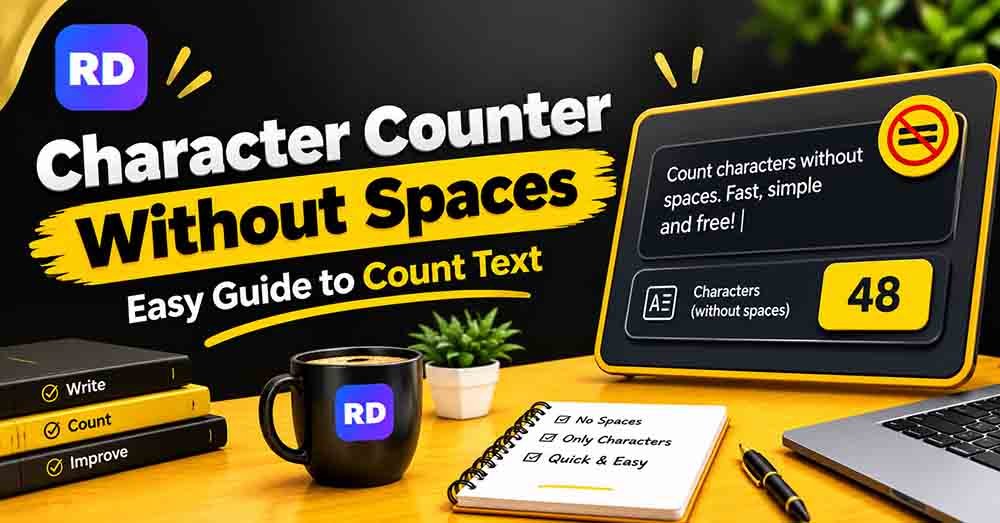
When writing a blog post, social media caption, or website description, you may need to know how many characters your text contains without spaces. A character counter without spaces helps you measure text length by excluding spaces between words from the total.
For example, the text “Hello World” contains 11 characters with the space included and 10 characters without it. This difference can matter when you need to follow specific writing requirements.
You can use the free online character counter tool on RandomsDex to check your text quickly. In this guide, you will learn how to count characters without spaces, calculate the total manually, compare different counting methods, and understand when this measurement is useful.
What Is a Character Counter Without Spaces?
A character counter without spaces is a tool or counting method that measures text while excluding spaces between words. Depending on the tool, it may still count letters, numbers, punctuation marks, and symbols.
For example, consider this sentence:
Text: I love design.
- Letters: 12
- Spaces: 2
- Full stop: 1
- Total with spaces: 15
- Total without spaces: 13
This example shows how removing spaces changes the final result.
A character counter without spaces is useful for writers, students, website owners, marketers, and anyone who needs to measure text length according to specific rules.
How to Count Characters Without Spaces Online
Using an online tool is usually faster than counting every character manually.
Follow these steps:
- Open the free text character counter.
- Copy the text you want to measure.
- Paste it into the text box.
- Check whether the tool displays a separate total without spaces.
- Review the result.
- Edit your text if you need to meet a particular limit.
Some tools display several measurements, such as total characters, characters without spaces, and word count. If the tool you use does not provide a separate result without spaces, you can calculate it manually.
How to Calculate Characters Without Spaces Manually
You can calculate text length without spaces by counting the letters, numbers, and punctuation marks while excluding ordinary spaces between words.
Consider this example:
Text: Hello World!
| Text part | Characters counted |
|---|---|
| Hello | 5 |
| Space | 0 |
| World | 5 |
| Exclamation mark | 1 |
| Total without spaces | 11 |
The sentence contains 12 characters when the space is included and 11 when it is excluded.
Step-by-Step Calculation Method
Use this simple method:
- Write down the complete text.
- Count every letter.
- Count any numbers.
- Include punctuation marks, such as commas and full stops.
- Exclude ordinary spaces between words.
- Add the remaining characters to find the total.
For short sentences, this method is easy. For longer paragraphs, manual counting can take more time and lead to mistakes. An online tool can make the process more convenient.
Examples of Character Counting Without Spaces
Here are some examples showing how removing spaces affects text length.
| Text | With spaces | Without spaces |
|---|---|---|
| Hello World | 11 | 10 |
| I love SEO | 10 | 8 |
| Good morning! | 13 | 12 |
| Count characters | 16 | 15 |
| I like design. | 14 | 12 |
| Welcome home | 12 | 11 |
These examples count letters and punctuation as individual characters and exclude only ordinary spaces in the last column.
If you want to compare both methods in more detail, read our guide on how to count characters with and without spaces.
Why Is Counting Without Spaces Useful?
Measuring text without spaces can be helpful when a task requires the number of characters excluding word separators. It can also help writers understand how much of their text consists of letters and punctuation rather than spaces.
1. Writing and Editing
Writers sometimes need to meet a specific text-length requirement. Checking the total without spaces gives them another way to measure their content.
2. Social Media Content
Social media platforms may set limits on posts, captions, and profile descriptions. However, each platform defines its own rules, and spaces often count toward its actual limit.
You can learn more from our guide on counting characters for social media posts.
3. Website Content
Website owners may check titles, summaries, and short descriptions before publishing. Measuring text length can help them edit unnecessary wording and keep their content concise.
4. Academic Writing
Students may need to follow specific requirements for assignments, summaries, or applications. If the instructions specify a character limit without spaces, this method helps them check their work.
5. Online Forms
Some forms have specific text-length requirements. Always confirm whether the form counts spaces before using a total that excludes them.
Character Counter Without Spaces vs. With Spaces
The main difference is whether ordinary spaces between words are included in the total.
| Feature | Without spaces | With spaces |
|---|---|---|
| Letters | Included | Included |
| Numbers | Included | Included |
| Ordinary spaces | Excluded | Included |
| Punctuation | Usually included | Usually included |
| Main use | Measure text excluding spaces | Measure the complete text length |
For example, “I love SEO” contains 8 characters without spaces and 10 with spaces.
Neither method is always better. The correct choice depends on the rules of your task. You can also read our article on word count vs. character count to understand the difference between measuring words and individual characters.
Do Punctuation Marks and Emojis Count Without Spaces?
Punctuation marks are generally counted even when spaces are excluded. For example, a comma, question mark, or full stop usually adds one character to the total.
Emojis and special symbols can be more complex. Some visible symbols contain multiple Unicode code points, even though they appear as a single character on the screen.
Keep in mind that excluding spaces does not automatically mean excluding punctuation, line breaks, or other symbols. Always check the counting rules used by your tool.
Benefits of Using an Online Character Counter
An online tool offers several advantages:
- Saves time: Check text in seconds instead of counting manually.
- Reduces mistakes: Avoid errors when measuring longer paragraphs.
- Supports editing: Find text that needs to be shortened.
- Makes comparisons easier: Review totals with and without spaces.
- Works in a browser: Most tools do not require software installation.
- Improves your workflow: Check content before publishing or submitting it.
For a broader explanation, visit our complete guide to character counting.
Tips for Getting an Accurate Result
Follow these tips when measuring text length:
- Confirm the method: Make sure spaces are excluded if that is what you need.
- Keep punctuation in mind: Most methods still count punctuation marks.
- Remove unwanted spaces: Extra spaces can affect the total when included.
- Check line breaks: Some tools handle new lines differently.
- Review emojis: Complex symbols may be measured differently across tools.
- Follow platform instructions: Use the exact method requested by the website or application.
- Check your final text: Recalculate after editing.
You can also read our online character counter guide to learn more about checking text length with a browser-based tool.
Frequently Asked Questions (FAQs)
1. What is a character counter without spaces?
It is a tool or counting method that measures text while excluding ordinary spaces between words. Letters, numbers, and punctuation are usually still included.
2. How do I count characters without spaces?
Paste your text into a tool that provides a separate count without spaces. Alternatively, count the letters, numbers, and punctuation manually while ignoring ordinary spaces.
3. Are punctuation marks included?
Yes, punctuation marks are usually included. Excluding spaces does not normally remove commas, full stops, or question marks.
4. Does removing spaces change word count?
No. Removing spaces for a character calculation does not automatically change the original number of words. Word count and character count measure different things.
5. Can I count a full paragraph without spaces?
Yes. You can measure a full paragraph using an online tool that supports longer text and provides a result without spaces.
6. Do emojis count as one character?
Not always. Some emojis consist of multiple Unicode code points, so different tools may display different totals.
7. Is a character counter without spaces useful for SEO?
It can help you examine text length, but search engines do not generally require website owners to measure every title or description without spaces. For SEO, focus on clear wording and the actual requirements of the platform.
8. Do social media platforms ignore spaces?
Not necessarily. Many platforms count spaces toward their text limits. Check the relevant platform’s rules before relying on a total that excludes them.
9. What is the difference between counting with and without spaces?
Counting with spaces includes the spaces between words. Counting without spaces excludes those spaces while usually keeping letters, numbers, and punctuation.
10. What is the easiest way to check text length?
An online character counter is usually the easiest option. It can measure text quickly and may provide several totals for different counting methods.
Conclusion
Measuring text without spaces can be useful when you need to follow specific writing instructions or understand the length of your content. It helps writers, students, marketers, and website owners check text more efficiently.
A character counter without spaces makes this process easier by excluding ordinary spaces from the total. Instead of counting each character manually, use the free RandomsDex character counter to check your text and review the available results.
Always confirm whether your task requires spaces to be included or excluded. With the correct counting method, you can prepare accurate text and avoid unnecessary editing.
Character counting can sometimes be confusing when text includes emojis, special symbols, or combined characters. The Unicode guide to characters and combining marks explains why some symbols may contain multiple underlying code points even when they appear as a single character on your screen. This information can help you understand character-counting differences and check text more accurately.
Comments