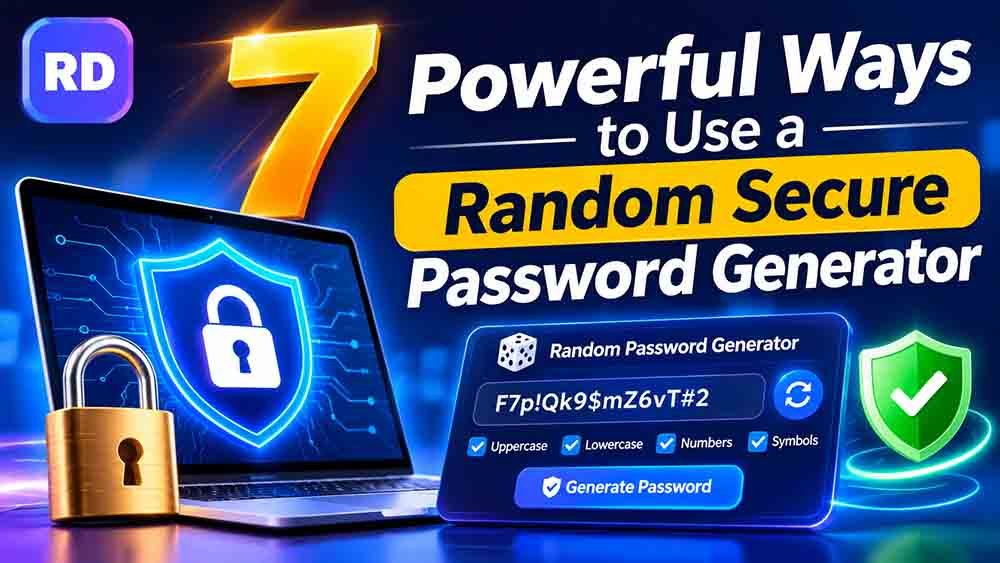
Keeping your online accounts safe starts with using strong passwords. Whether you use email, social media, online banking, or shopping websites, a secure password helps protect your personal information.
A random secure password generator makes it easy to create passwords that are difficult to guess. Instead of using your name, birthday, or common words, you can generate a random combination of letters, numbers, and special characters.
For example, a password like T8@mQ4#vL9!pX2 is more complex than a simple password like hello123.
If you want to create a secure password quickly, try this free online password generator. It can help you generate random passwords for different online accounts.
In this guide, you will learn how password generators work, how password strength is calculated, and how to create strong passwords to protect your accounts.
Table of Contents
- What Is a Random Secure Password Generator?
- Why Should You Use a Random Secure Password Generator?
- How to Create a Strong Random Password
- How Password Strength Is Calculated
- Random Secure Password Generator Examples
- Benefits of Using an Online Password Generator
- What Makes a Password Secure?
- Common Password Mistakes to Avoid
- Frequently Asked Questions
- Conclusion
What Is a Random Secure Password Generator?
A random secure password generator is an online tool that creates passwords using different types of characters.
These characters can include:
- Uppercase letters: A, B, C, D, E
- Lowercase letters: a, b, c, d, e
- Numbers: 1, 2, 3, 4, 5
- Special characters: @, #, $, %, &, !
The tool combines these characters to create random passwords.
For example:
R7@mL9#qT2!vP5
This password contains uppercase letters, lowercase letters, numbers, and special symbols.
You can also choose the password length according to your needs. A longer, randomly generated password generally provides more possible combinations.
Why Should You Use a Random Secure Password Generator?
Using a random password generator has several benefits. It helps you create passwords without using common words or personal information.
Here are some important reasons to use one.
1. Creates Random Passwords
Random passwords are less predictable than passwords based on names, birthdays, or common words.
A good generator creates combinations that are difficult for other people to guess.
2. Improves Password Strength
Using different character types increases the number of possible combinations.
You can combine uppercase letters, lowercase letters, numbers, and symbols to create stronger passwords.
3. Saves Time
You do not need to think of a new password every time you create an account.
An online tool can generate a random password within seconds.
4. Helps Protect Personal Information
Strong and unique passwords make it harder for someone to access your online accounts through password guessing.
5. Supports Different Password Lengths
You can choose a password length based on the website’s requirements.
For example, you may generate a 16-character password for a personal account or a longer password for an important account.
How to Create a Strong Random Password
Creating a strong password is simple when you follow the right steps.
Step 1: Choose a Password Length
First, decide how long your password should be.
For most personal accounts, a unique password of at least 16 characters is a good choice.
Longer passwords generally provide more possible combinations.
Step 2: Select Uppercase and Lowercase Letters
Include both capital and small letters.
For example:
aB7mQ9vL
Using both letter types creates more possible combinations than using lowercase letters alone.
Step 3: Add Numbers
Numbers make your password more varied.
For example:
aB7mQ9vL2p
Avoid predictable number patterns such as 123456 or your birth year.
Step 4: Include Special Characters
Add special characters such as @, #, $, %, and ! if the website supports them.
For example:
aB7@mQ9#vL2!p
Step 5: Generate a Random Password
Use a reliable password generator to create a random combination.
You can also try this online random password generator to create different password combinations.
Step 6: Save Your Password Safely
After generating a password, save it in a trusted password manager.
Avoid using the same password for different accounts.
How Password Strength Is Calculated
Password strength can be estimated by looking at two main things:
- The number of possible characters.
- The total number of characters in the password.
A simple mathematical formula is:
Total Possible Combinations = Character Set Size ^ Password Length
Let’s understand this with an example.
Step-by-Step Password Calculation
Suppose you create a password using:
- 26 uppercase letters
- 26 lowercase letters
- 10 numbers
- 10 special symbols
The total character set is:
26 + 26 + 10 + 10 = 72 characters.
Now suppose your password has 8 characters.
The calculation becomes:
72⁸ = 722,204,136,308,736 possible combinations.
This means there are more than 722 trillion possible combinations under these assumptions.
If you increase the password length to 12 characters, the number of possible combinations becomes much larger:
72¹² = 19,408,409,961,765,342,617,600 possible combinations.
Why Does Password Length Matter?
A longer password provides more possible combinations when characters are selected randomly.
For example:
| Password length | Character set | Possible combinations |
|---|---|---|
| 8 characters | 72 | 72⁸ |
| 10 characters | 72 | 72¹⁰ |
| 12 characters | 72 | 72¹² |
| 16 characters | 72 | 72¹⁶ |
| 20 characters | 72 | 72²⁰ |
This formula assumes that each character can be selected from all 72 options and that characters can repeat.
The actual security of a password also depends on randomness, website security, and how passwords are stored. A predictable password may be weak even if it contains many different character types.
Random Secure Password Generator Examples
Here are some examples of passwords with different character combinations.
| Password example | Character types | General strength |
|---|---|---|
hello123 | Lowercase and numbers | Weak |
Hello123 | Uppercase, lowercase, numbers | Weak |
H7mQ2vLp | Uppercase, lowercase, numbers | Better |
H7@mQ9#vL2!p | All character types | Stronger |
T9#vLm2!qR8@xP5z | All character types, longer length | Stronger |
These examples are for learning only. Do not use passwords published in articles for your real accounts.
A good random secure password generator should create unpredictable combinations instead of using common words or simple patterns.
Benefits of Using an Online Password Generator
An online password generator makes password creation easier and faster.
Here are some useful benefits.
Easy to Use
Most password generators have simple settings. You can select your preferred length and character types without technical knowledge.
Creates Unique Passwords
You can generate a different password for every account.
This is important because using the same password on multiple websites can put several accounts at risk.
Offers Multiple Character Options
You can choose uppercase letters, lowercase letters, numbers, and special characters.
Generates Long Passwords
Many tools support different password lengths, making it easier to create passwords for accounts with different requirements.
Helps Improve Online Security
A randomly generated password can reduce the risk of password guessing when used with other good security practices.
For more helpful advice, read this guide on how to create a strong password.
What Makes a Password Secure?
A secure password should be long, random, and unique.
Here are some important things to remember.
Use a Longer Password
A longer password generally provides more possible combinations.
For most personal accounts, 16 or more randomly generated characters is a practical choice.
Avoid Common Words
Words such as password, welcome, admin, and your personal name are easy to guess.
Use random combinations instead.
Never Reuse Passwords
Create a different password for every account.
If one website experiences a data breach, unique passwords help protect your other accounts.
Use a Password Manager
A password manager can store your passwords securely so you do not need to remember every combination.
Enable Two-Factor Authentication
Two-factor authentication adds another security step when signing in.
Even if someone discovers your password, this extra step can help protect your account.
Common Password Mistakes to Avoid
Even when using a password generator, you should avoid these common mistakes.
Using Personal Information
Do not include your name, birthday, phone number, or other personal details in your password.
These details may be easy to discover.
Choosing Simple Patterns
Passwords such as Password123! may look complicated, but they follow predictable patterns.
Random combinations are a better choice.
Using Short Passwords
Short passwords generally have fewer possible combinations.
Choose a longer password whenever the website allows it.
Sharing Your Password
Never share your password through public messages or unsecured channels.
Saving Passwords in Unsafe Places
Avoid keeping passwords in public documents or unsecured notes.
Use a trusted password manager instead.
Frequently Asked Questions
What is a random secure password generator?
A random secure password generator is an online tool that creates random passwords using uppercase letters, lowercase letters, numbers, and special symbols. It helps users create stronger passwords for their accounts.
Are random passwords safer than normal passwords?
Random passwords are generally harder to guess than passwords based on common words, names, or personal information. Their security also depends on length and how randomly they are generated.
How long should a secure password be?
A unique password of at least 16 characters is a good choice for most personal accounts. Longer passwords can provide even more possible combinations.
Should I use numbers and symbols in my password?
Yes, when supported by the website. Numbers and special characters increase the available character set and can improve password strength.
Can I use a random password generator for email accounts?
Yes. You can use a reputable password generator to create a unique password for your email account. Email accounts are especially important because they can be used to reset passwords for other services.
Is an online password generator safe?
A reputable generator can help you create strong passwords. For sensitive accounts, choose a tool that uses secure random generation and does not store or share your passwords.
Can I generate a 24-character password?
Yes. Many online tools allow you to create longer passwords. You can use this 24-character password generator to generate a longer random combination.
Should I use the same password everywhere?
No. Every account should have a unique password. Reusing passwords increases the risk that one compromised account could affect other accounts.
Conclusion
Protecting your online accounts starts with creating strong and unique passwords. Using uppercase letters, lowercase letters, numbers, and special symbols can increase the number of possible combinations.
A random secure password generator makes it easy to create unpredictable passwords without spending time thinking of complicated combinations.
Choose a suitable password length, avoid personal information, and use a different password for every account. You should also save your passwords in a trusted password manager and enable two-factor authentication wherever possible.
Start creating stronger passwords today and take an important step toward keeping your online accounts safe.
For more online security advice, visit the official CISA guide to using strong passwords. It explains how to create secure passwords, use password managers, and protect your online accounts.